
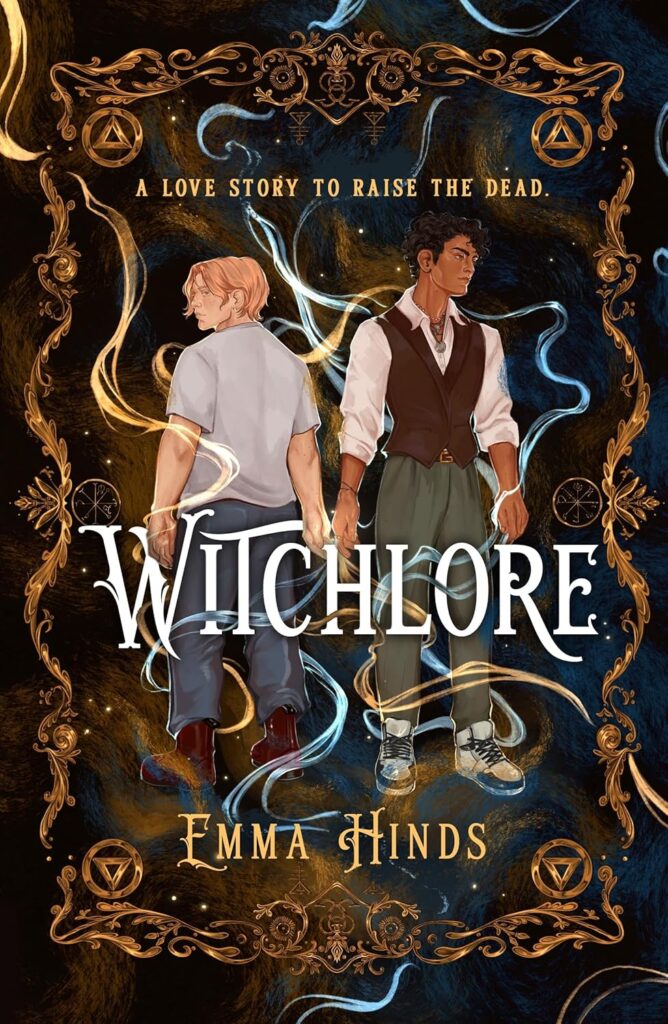
Witchlore brings together a shapeshifting outcast and a new student at Demdike College of Witchcraft. Orlando feels like an outcast at college, and it isn’t because he has no control over his magic. The truth is that he became an outcast after the death of his girlfriend, Elizabeth, for which he has taken the blame.
In comes Bastian, a charming new student who offers Orlando the chance to use a spell that will bring Elizabeth back to life. But as Orlando ponders whether to take the offer or not, he begins to develop feelings for Bastian, wondering who exactly this new student is.
We spoke to Emma Hinds about magical folklore, the importance of queer stories, and what readers can expect from this story.
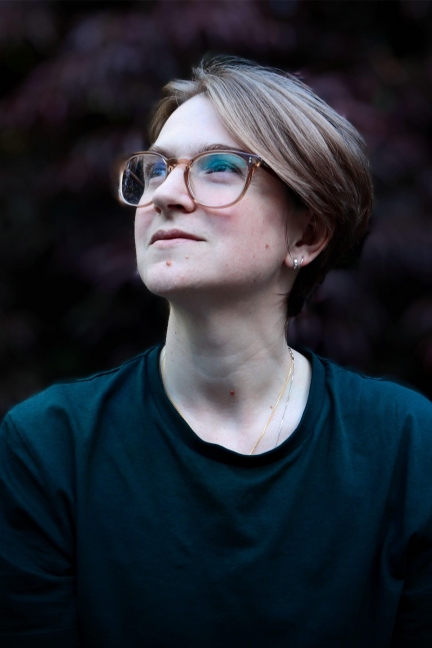
Eulalie Magazine: Why do you think that the topics of magical folklore continue to interest and intrigue readers all these years later?
Emma Hinds: I think people seek out enchantment in the world. The exciting thing about folklore is it is often based on local stories using familiar locations and tropes. In Witchlore, the magical creatures are based on folklore tales from around Manchester, where I live – the haunting of Manchester Cathedral, the magical cave in Alderley Edge, the drowned village of Kilgrimol – these are stories that infuse the ground and world I walk in today. I think there’s delight for readers in imagining everything is the same … but all the fairy stories are true!
Eulalie Magazine: When creating characters like Orlando and Bastian, where do you get your inspiration from?
Emma Hinds: All over the place! Orlando’s dark sense of humour is very much inspired by my time as a youth worker working with young people in high schools, but their journey is also partly inspired by Orlando by Virginia Woolf. My characters are always a real mixed bag of literary heritage, lived experiences, research, and pure imagination. The only character in the book that is absolutely a carbon copy of someone from the real world is Bastian’s French bulldog, René, based on my friend’s dog, the utterly adorable Amis, who absolutely deserved to be immortalised in literature.
Eulalie Magazine: What do you hope people take away from this story?
Emma Hinds: That there is always something to live for.
Eulalie Magazine: Do you believe there is a tight connection between the queer community and the fantasy genre? Why do you think that is?
Emma Hinds: It is my experience that there is a queer community in every genre because we are a diverse group of human beings with diverse reading tastes! From my own perspective, I have always loved the possibility that comes in fantasy and magical realism. The chance to remake the world is compelling to me.
Eulalie Magazine: With the heavy impact of legislative agendas on trans and queer people worldwide, how important do you think it is for the entire queer community to be represented in literature and culture?
Emma Hinds: When governing bodies devalue the voice of a marginalised group, understandably, the public looks to the Arts to raise up the voice of that group. Literature can give us solace from the hurt of the world, can help us feel seen, but it can also give us hope and embolden us to keep fighting back against unjust legislation. There are so many incredible trans writers that embolden me who are telling amazing stories across genres; I go to Nat Reeve for delightful Victorian detective capers, to Nicola Dinan for searing literary fiction, and to Alison Rumfitt for gut-churning horror.
Eulalie Magazine: Is there anything you’d say to queer authors getting started?
Emma Hinds: There are lots of reasons why a person might struggle to get started when writing. From my own experience, I can come up with about twenty-five different excuses just before lunch time, but that’s mainly procrastination. However, one that I see most commonly in new writers is that their inner critic is too loud. Even before they’ve set pen to paper, they are tangled in a preemptive judgment negating the value of their work. Sometimes, a new writer needs to be freed from the expectation of readership. Tell yourself that no one will ever read it and just write. Free yourself from the inner critic and the pressure that comes with it. Make it a secret. Just write. Enjoy the process.
Follow us on X and on Instagram!
Like us on Facebook!
Lara Rosales

By day, Lara Rosales (she/her) is a solo mom by choice and a bilingual writer with a BA in Latin-American Literature known as a Media Relations Expert. By night, she is a TV enjoyer who used to host a podcast (Cats, Milfs & Lesbian Things). In addition to Eulalie Magazine, you can find her work published on Tell-Tale TV, Geek Girl Authority, W Spotlight, Collider, USA Wire, Mentors Collective, Instelite, Noodle, Dear Movies, Nicki Swift, and Flip Screened.