
With literary thrillers increasingly leaning into body horror and class critique—much like The Substance did cinematically—Salomé arrives at precisely the right cultural moment. Author Leslie Baird understands that the most effective horror often wears a beautiful face.
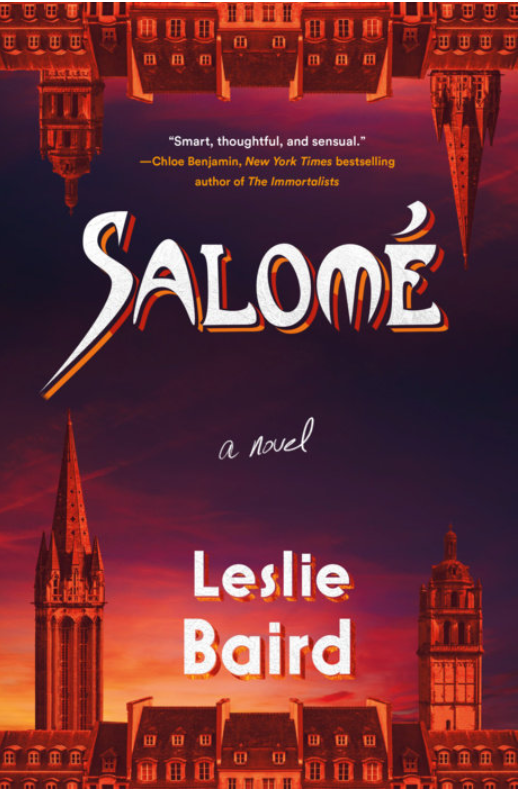
The premise unfolds elegantly: Courtney, a recently unemployed American journalist, meets the enigmatic Salomé amidst a flight to Paris, France. What begins as an impulsive weekend escape to Châteaubriant gradually reveals itself as something far more sinister.
The setup feels familiar, yet Baird executes it with enough atmospheric control to keep pages turning. Moreover, the novel’s greatest strength lies in its sensory world-building.
Baird constructs the scene through meticulous attention to texture, creating an environment that seduces both Courtney and the reader. These details aren’t mere decoration—they’re integral to the book’s themes of consumption, literally and metaphorically.
The longevity industry subplot provides the novel’s thematic backbone. Without spoiling specifics, Baird explores how the wealthy commodify youth and bodies in ways that echo vampire mythology while feeling distinctly modern.
It’s territory that writers like Silvia Moreno-Garcia and Rachel Harrison have explored well, but Baird brings her own perspective to the conversation.
Furthermore, the feminist reclamation of the Salomé myth operates on multiple levels. The biblical Salomé—dancing for Herod, demanding John the Baptist’s head—has been interpreted by countless male artists from Oscar Wilde to Richard Strauss.
Baird flips the traditional femme fatale framework, making Salomé more agentic, rather than a mere object of male desire. However, this mythological connection occasionally feels surface-level rather than deeply integrated.
The parallels are present but not always earned through the narrative structure. Readers seeking a more explicit engagement with the source material might find themselves wanting more direct conversation between old myth and new interpretation.
The pacing moves deliberately rather than propulsively. Baird favors atmosphere over action, which suits the material but may frustrate readers expecting conventional thriller momentum. This is fever dream territory—disorienting, seductive, occasionally stagnant—which appears intentional rather than accidental.
Nevertheless, when the novel does accelerate in its final third, the payoff feels earned. Baird has been planting seeds throughout, and the harvest delivers both thematic resonance and narrative satisfaction. The question of complicity versus exposure drives Courtney’s arc to a conclusion that refuses easy answers.
The prose itself walks a careful line between literary ambition and commercial accessibility. Baird can craft a gorgeous sentence without disappearing into purple excess. Her descriptions of the château, the food, the wine—all serve character and theme rather than existing for their own sake.

In addition, Courtney functions effectively as an unreliable-ish narrator. She’s professionally adrift, personally uncertain, and prone to romanticizing what she observes. This instability makes her perfect prey for Salomé’s world, while also creating productive tension for the reader about what to trust.
The novel’s examination of the “patriarchal bargain”—the compromises women make to access male power—feels particularly resonant. Baird doesn’t lecture; instead, she dramatizes these dynamics through character choices and consequences. The result feels more authentic than polemical.
Does Salomé fully reinvent the gothic novel or create something stunningly original? Perhaps not. The “wealthy elite harvesting youth” plot has appeared in everything from horror films to science fiction to beauty industry critiques. Baird’s contribution lies in execution rather than pure innovation.
What she does accomplish, nonetheless, is crafting a compelling entry in the literary thriller tradition that takes its themes seriously. The book engages with genuine questions about class, consumption, and female agency without sacrificing narrative pleasure. That balance proves harder to achieve than it might appear.
For readers who appreciate atmospheric slow burns with thematic substance, Salomé delivers.
For those seeking breakneck pacing or radical formal experimentation, this may feel too measured. The novel knows what it wants to be—a seductive, unsettling meditation on power disguised as a thriller—and commits fully to that vision.
Ultimately, Baird’s debut suggests a writer with clear control over her craft and interesting preoccupations. Salomé may not revolutionize contemporary fiction, but it demonstrates that familiar frameworks can still yield fresh insights when handled with intelligence and care.
In a market saturated with derivative thrillers, that’s worth celebrating.
—
Salomé is a 2026 debut novel by Leslie Baird, published by Putnam. It releases on May 19, 2026 wherever books are sold.
Follow us on X and on Instagram!
Like us on Facebook!
Quinn Quē

Quinn Quē is a storyteller & journalist writing regular interviews, reviews, and features. They've been fascinated with the multidisciplinary arts since a child, particularly film, literature, and television. They love microblogging, so feel free to hit them up on Substack Notes or Tumblr about any recent articles or just to shoot the pop culture breeze!