
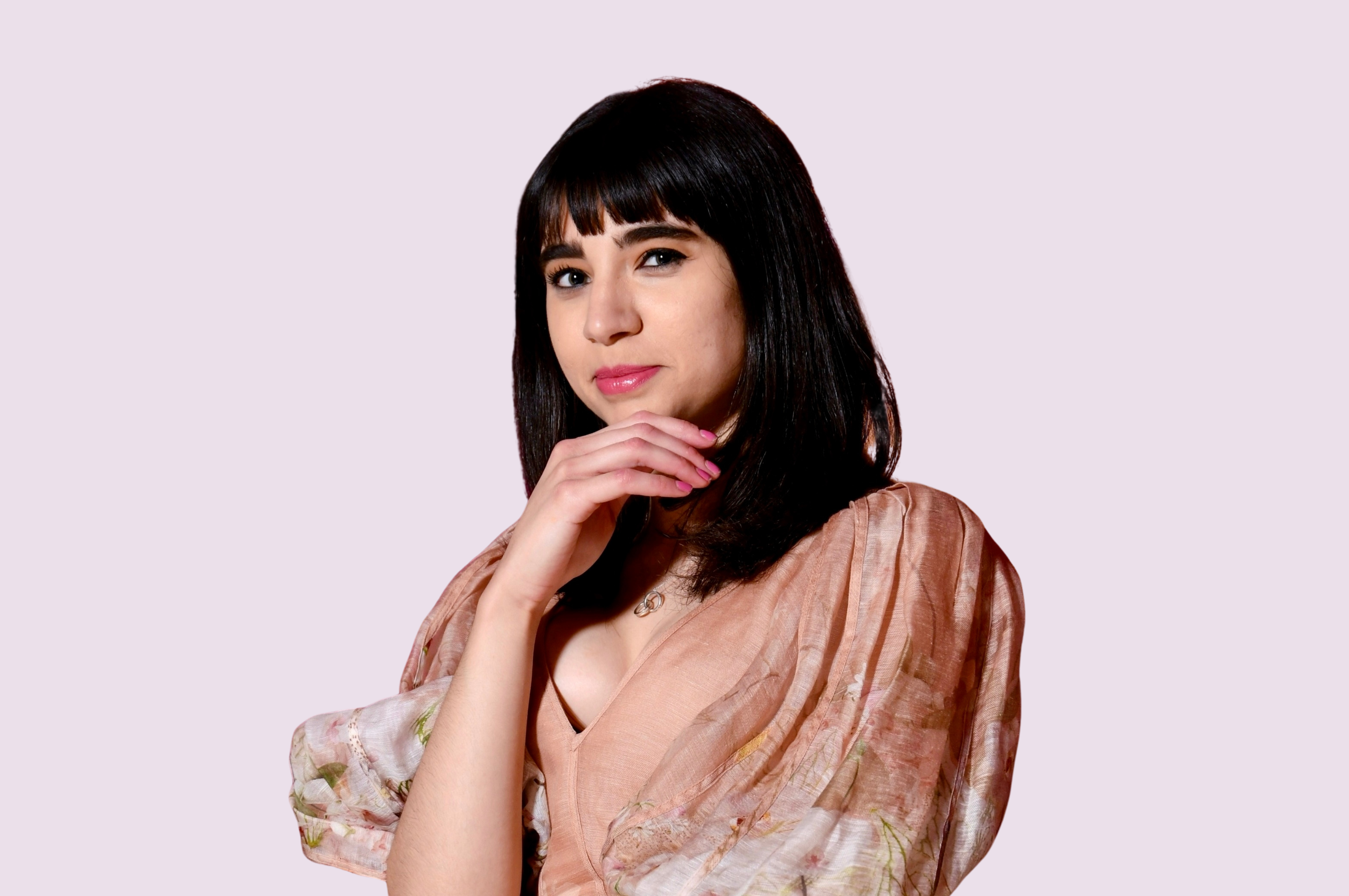
When Liza Libes (LEE-zah LEE-bess) talks about her post-Soviet immigrant background, she doesn’t reach for tragedy or hardship narratives. Her parents fled the Soviet Union as refugees in the late 1980s, and Libes grew up straddling two worlds: the Soviet culture of her parents’ and grandparents’ memories, juxtaposed with the American present she grew up in. This in-between-ness shapes much of her writing and worldview.
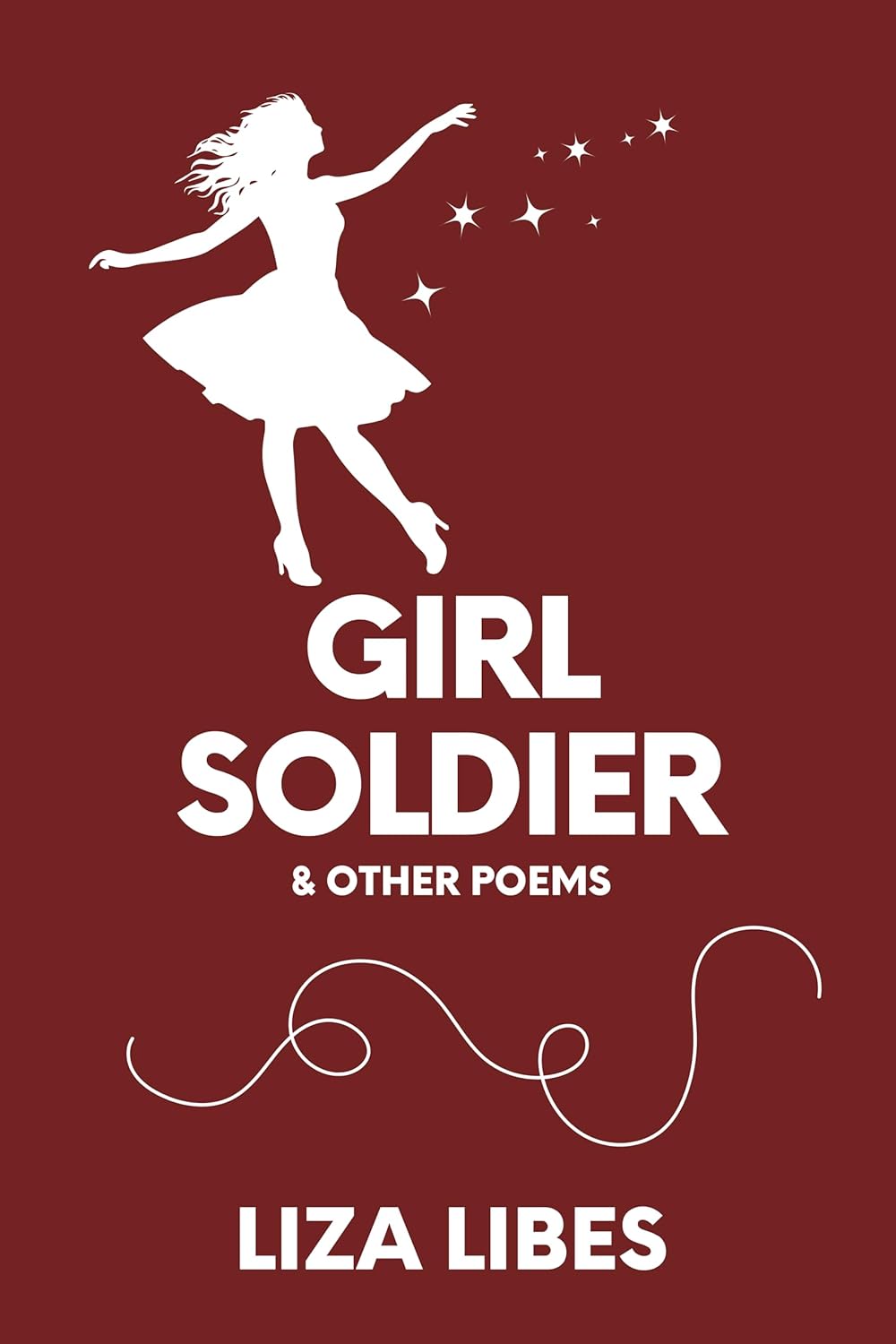
I recently spoke with Libes about how that background influences her writing and her debut poetry collection, Girl Soldier & Other Poems.
“It’s the reason I don’t like to use the word ‘Russian’ as much,” Libes explained. “Russia today is very different from the Soviet Union. I resonate more with Soviet culture—it’s a very weird kind of identity, and it’s also one of those things that’s now fully obsolete.”
Her parents, like many immigrant families, wanted stability for their daughter. Engineering. STEM. Something functional. But Libes had other ideas. She worked relentlessly in high school, determined to attend an Ivy League school. When her father saw her work ethic, something shifted. “He kind of said, ‘You’re smart. I’ve seen you put all this really hard work in. I believe in your work ethic. Go study English,'” she recalled.
She had convinced them she wouldn’t become a starving artist — that she would do something. And she did.
What really pulled her toward poetry wasn’t a youthful rebellion, though. It was her grandmother. From the age of three, Libes memorized Russian poems by Alexander Pushkin, falling in love with the rhythm of language as an oral, performative act. “I think one thing that I really do believe is so important in both prose and poetic writing, is it has to sound good when it’s read out loud,” Libes said.
This early exposure to poetry as something spoken, not just read, became foundational to her aesthetic.
In grade school, Libes discovered T.S. Eliot’s “The Wasteland,” a poem she’d been intrigued by since age 12 but never fully grasped. Rereading it in high school, she fell in love—not just with his language, but with his diagnosis of modern alienation.
“I was an introverted kid. I had a lot of trouble connecting with people when I was in school. I guess that kind of alienation resonated with me,” she said. She didn’t discover Sylvia Plath until college, but found similar ground there.
Unlike typical Plath readers, Libes isn’t drawn primarily to the feminist critique. Instead, she’s interested in Plath’s exploration of human alienation, the feeling of being fundamentally misunderstood. Libes sees the two poets as kindred spirits, enjoying Plath for “the same things that drew me to Eliot, the human alienation and feeling a little bit like an outsider.”
This preoccupation with disconnection, with the failure of human connection, runs through everything Libes does. These days, however, she’s juggling multiple identities. Libes runs a college prep consulting company, the work that funds her whole operation. She writes essays on Substack under the banner of Pens and Poison, where she interrogates the state of publishing and literary academia from an insider’s perspective.
Libes posts bite-sized content on Instagram to younger audiences. She writes novels that she’s still querying to publishers. She’s a poet, a businesswoman, an essayist, even a literary “influencer” (a word she begrudgingly says with visible discomfort).
“I struggle with that myself,” she responded when asked who Liza Libes actually is. “I think I tend to answer that question differently based on the crowd I’m in. If I’m in an artsy crowd, I lead with the writing. If I’m in a corporate crowd, I lead with the business owner side.”
Ideally, she said that she would introduce herself simply as a writer. But the consulting company is “probably the most lucrative application of my talents, versus sitting there writing articles, which isn’t going to pay my rent.”
Still, her heart is clearly in the writing. Before Pens and Poison, no one was reading her work. A friend suggested Substack. One essay about the state of publishing and literary academia went viral, earning 2,000 subscribers.
Suddenly, there was an audience for her particular perspective: someone who’d survived Ivy League English programs, who understood the challenges and orthodoxies of academia, who could speak to what some view as an institutional rot, all whilst avoiding the pitfalls of outside agitator status.
“There’s actually a huge audience for people who are upset about what’s going on in publishing, upset about what’s going on in academia, especially English literature,” she said.
Her audience and platform grew from there. Now she’s at 40,000 followers on Instagram. The momentum is real. But there’s a weariness in how she describes the social media work—a sense that this is what’s required to be heard, even if she’d rather just be left alone to write.
Her debut poetry collection, Girl Soldier & Other Poems, is the product of that tension.
The title poem came to her in a dream: a young woman resentful of her lover for going off to war, a meditation on abandonment and the complicated, allegorical strife of the metaphorical battlefield that love can be. “I wanted to write several poems that kind of explored this messy side of love.”
Her poems tend to read like short stories or vignettes—narrative-heavy, dream-inspired, exploring the impossibility of human connection.
The collection defies easy categorization. Some poems are narrative poetry. Some are prose poetry. Some are hybrid forms she doesn’t have a clean word for. When asked why she chose “poetry” as the umbrella term, she laughed a little. “‘Poetry’ is just kind of the umbrella term that captures most of it, maybe the most accurate, like, layperson term for the sort of niche that I’m occupying here.”
This refusal to be pinned down extends to her formal choices. In an American literary tradition that has resisted rhyme and meter for decades, Libes borrows freely from everywhere. Some poems have near rhymes, some have obvious line breaks, some veer into pure prose. She sees this eclecticism as a kind of freedom, a resistance to the rigid rules of both formalism and its backlash.
“I don’t like rules, I think, is the best answer for that,” Libes said. “The publishing industry bothers me so much because there are all these rules. Your first chapter has to have this, your word count can’t exceed that, and you must have certain types of characters. I think that writing to me is just such a free expression. It shouldn’t be something like, you know, it has to be this or that.”
“I don’t like being told, ‘Oh, you can’t use rhymes,’ because I think that obviously that’s a great literary device. But I also don’t like being told that your poem has to be in iambic pentameter.” Instead, Libes operates case-by-case, borrowing from everything.
One of Girl Soldier‘s most striking poems is “Yellow,” inspired by a Passover seder during the 2024 campus protests. Libes watched a young child—about to have his bar mitzvah—confront the reality of antisemitism for the first time. “I was left with this impression of a young Jewish kid who was just, like, very confused. ‘Why is everyone hating us all of a sudden?'” The poem crystallizes that moment of disillusionment.
She doesn’t usually tackle identity so directly in her work. “I don’t like writing identity poems that often because I think it’s one of those things that’s kind of overdone at this point,” she said. But this one felt necessary. She needed to open the collection with something that showed who she was and what she was wrestling with in that moment.
Another politically charged poem is “Crematorium of Art,” an explicit critique of how what she describes as “far-left attacks” on artistic freedom are coming via rigid ideological prescriptions. She almost didn’t include it. “I don’t like political poetry that much,” she admits. But her fiancé convinced her to keep it, and she realized the thematic break would strengthen the collection. “Art is kind of a bridge that demonstrates our shared humanity,” she noted. “And I really have seen that under attack a lot.”
The collection ends with “Astronaut,” which Libes wrote near the end of the project when she was feeling isolated and exhausted from the intimacy of her own work. She wanted to close on something explicit and accessible—the theme of loneliness that echoes throughout. “It just captured the spirit of my headspace,” she said.
Beyond Girl Soldier, Libes has finished a novel, The Leverkühn Quartet, about a post-Soviet woman who quit music for stability and slowly returns to what it means to have an artistic soul. She’s querying agents, though college application season has forced her to pause. “I’ve had some interest from literary agents who are currently reading it. It’s a struggle, but I remain optimistic, and I will not give up until my books are published.”
When asked for advice to young writers navigating publishing and social media, she’s blunt about the reality: “Social media is a must. I wish it weren’t. I’m not a social media person. But I did not have anyone reading any of my writing until I got on social media.”
That said, Libes doesn’t recommend the hustle for its own sake. “I would say just kind of don’t be afraid of putting yourself out there,” she offered. “I tend to ignore the negativity, focus on people who positively respond to my work.” She thinks about the readers who’ve told her that her writing moved them to tears. That makes it all worth it, in her book.
“I think the most important thing for me personally is just to get my ideas out there,” Libes said. “I think it’s just necessary for there to be some sort of counteracting voice to what’s going on in mainstream publishing right now, which I think is very much an echo chamber. So, I think the best thing that anyone can do, like young writers or young people just trying to get their work out there, is just put yourself out there.”
There’s surprisingly little bitterness in how she says this, just a kind of clear-eyed pragmatism. Libes has learned to navigate systems she doesn’t entirely believe in, to use platforms she doesn’t love, all in service of getting her ideas heard. It’s not glamorous. But it’s working.
Follow us on X and on Instagram!
Like us on Facebook!
Quinn Quē

Quinn Quē is a storyteller & journalist writing regular interviews, reviews, and features. They've been fascinated with the multidisciplinary arts since a child, particularly film, literature, and television. They love microblogging, so feel free to hit them up on Substack Notes or Tumblr about any recent articles or just to shoot the pop culture breeze!
One thought on “Liza Libes on Politics, Publishing, and Her Poetry Collection ‘Girl Soldier’”
Comments are closed.