
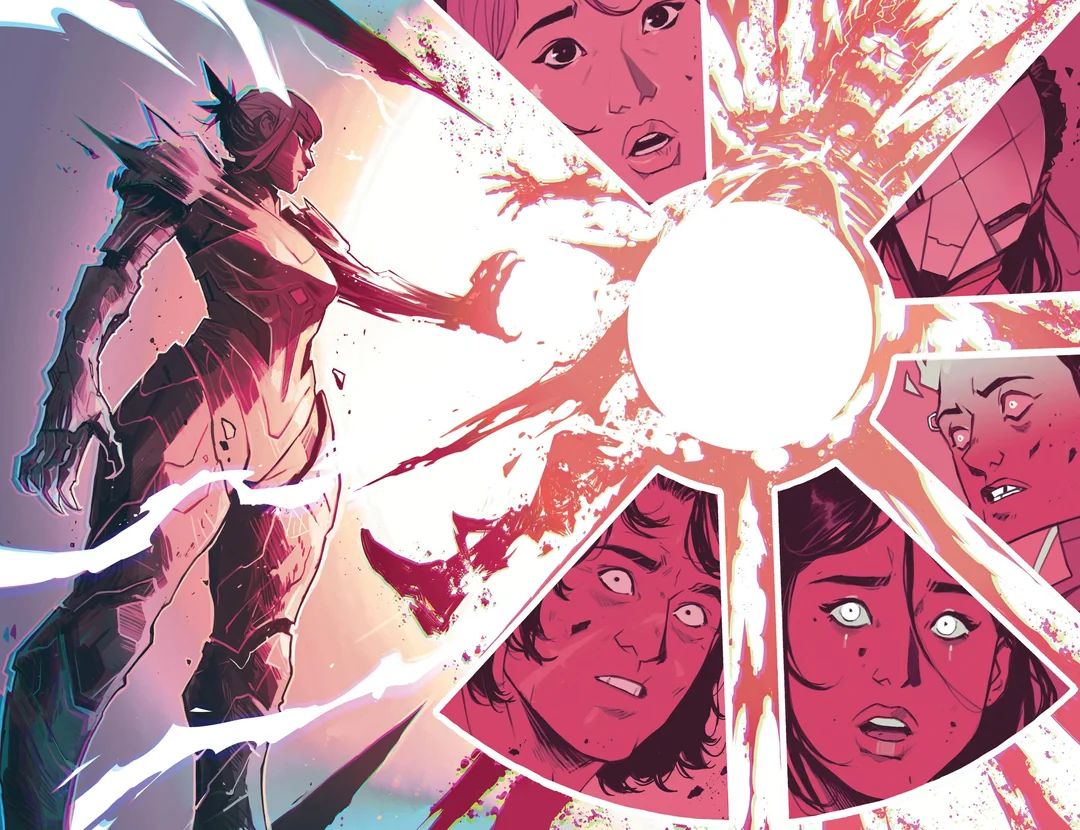
The Power Fantasy, by writer Kieron Gillen and artist Caspar Wijngaard, was already one of the best ongoing comics of its generation before these two volumes arrived. Vols. 2 and 3 don’t just maintain that standard; they vindicate it.
The premise is elegant and unnerving. Six individuals each possess the destructive capability of the American nuclear arsenal. The world survives only so long as they never come into open conflict with one another.
The series is, consequently, technically a superhero comic that’s primarily about not using superpowers. It is also, consequently, one of the most tension-sustained works in the medium.
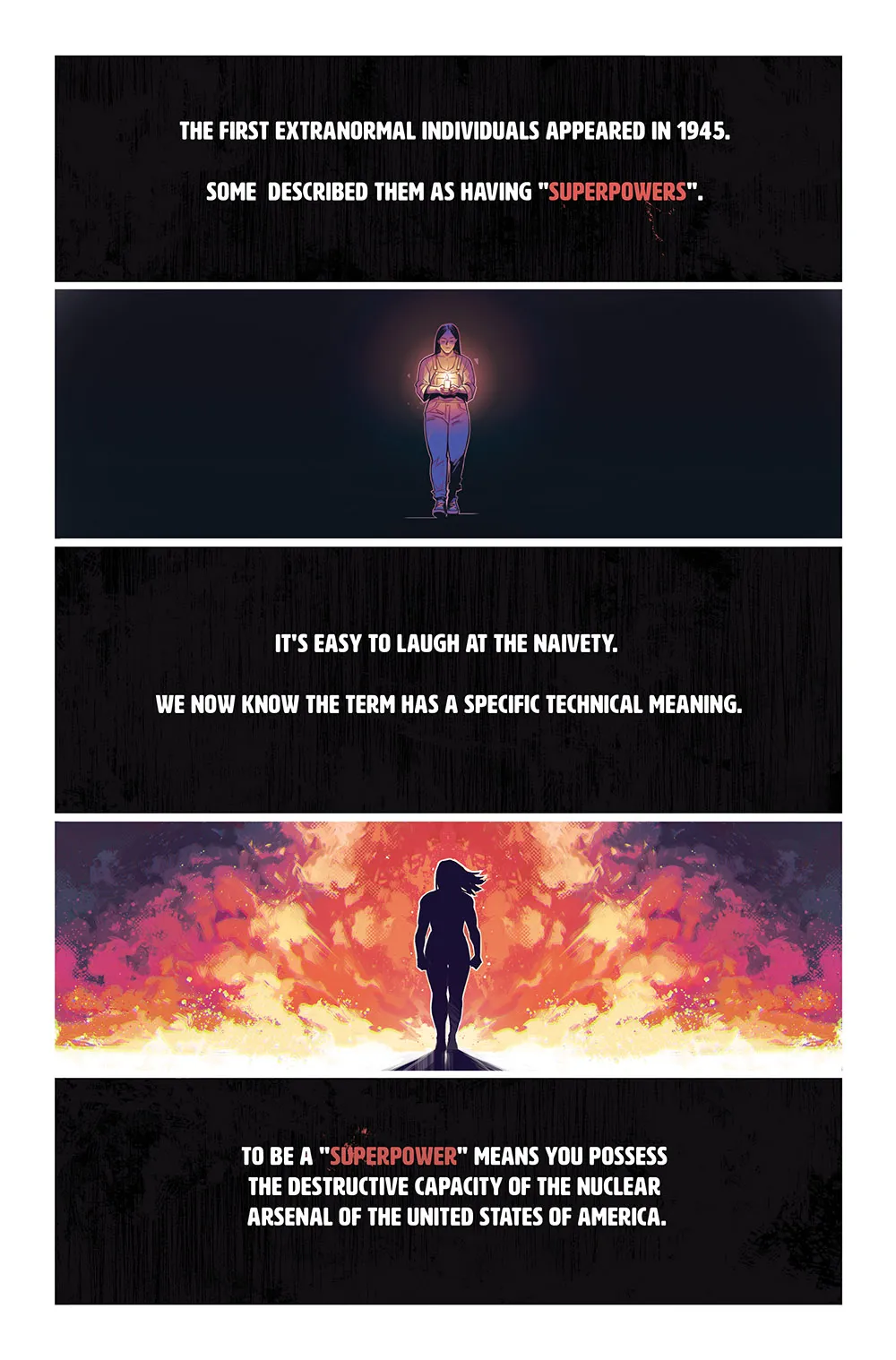
Vol. 2, subtitled Mutually Reassuring Destruction and containing issues #6–11, is where the Jenga tower starts to visibly sway.
The detente holding the six principals in check — Etienne, Eliza, Masumi, “Jacky,” “Heavy,” and Valentina — is a structure built on personality management as much as mutual terror. Gillen, to his great credit, understands that political stalemate is fundamentally a character problem. The blocks being pulled here are psychological ones.
Furthermore, Wijngaard’s art earns sustained superlatives across this volume.
His approach to depicting both powers and people — impressionistic, even abstract, rendered in vivid color fields that feel emotionally rather than mechanically calibrated — gives the series a visual register unlike anything else on shelves.
These are not laser beams and punches. These are events. The art treats them accordingly.
Vol. 3, The End of History (issues #12–16), is where the season comes to its close, and it is extraordinary.
In the wake of an assassination attempt, the already-fragile equilibrium collapses inward. Gillen, who has been telegraphing the arc’s endgame for months in his letters column in the back of the monthly issues, sticks the landing with a precision that is frankly rare in contemporary serialized comics.
A particular narrative device deployed across Vol. 3 — one that would constitute a spoiler to name — is executed as well as anything in the medium in recent memory. It more than earns the series’ sometimes-cheeky title. It recontextualizes it entirely.
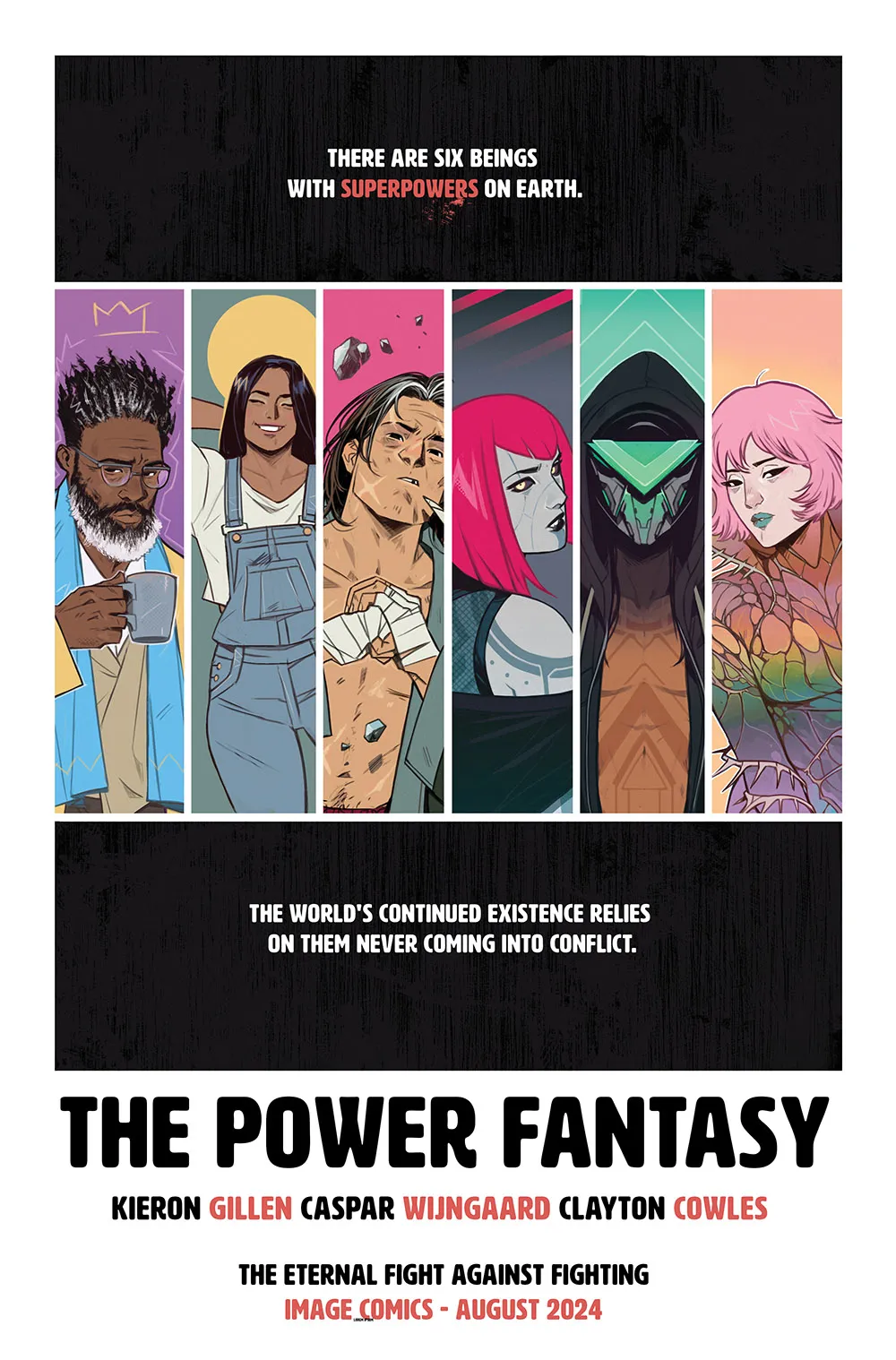
Characters, from left to right: Etienne Lux, Santa Valentina, Brother Ray “Heavy” Harris, Eliza Hellbound, Jacky Magus, and Masumi.
This is also, it should be said, a beautiful book in the most literal sense.
Wijngaard’s work on the sequences depicting alternate timelines, hinted heavenly realms, and voidful hellscapes. The geography of sheer majesty, often beyond what humans can even comprehend, is some of his best anywhere.
It is rare to bring daring, almost unrenderable imagery to life well in visual media. It is even rarer to create comics that still feel evocative in a way not unlike traditional prose.
Wijngaard’s art doesn’t replace the reader’s imagination; the pictures enhance and spark it.
Audiences will be left fantasizing about what they witnessed and what they didn’t, filling in the blanks with their own visions. For a medium that is often derided as anti-literary or too didactic, this is quite the feat. Letterer Clayton Cowles threads the needle of a book that moves between quiet domestic menace and world-ending spectacle without ever losing its visual coherence.
Still, there is a caveat that must accompany any recommendation here. One that applies to most fiction series in some sense, but is made doubly or triply applicable in the comics medium.
The Power Fantasy is serialized fiction with a rich, cumulative universe. Some individual issues within these volumes are designed to feel self-contained, and they do work in that way, to some extent.
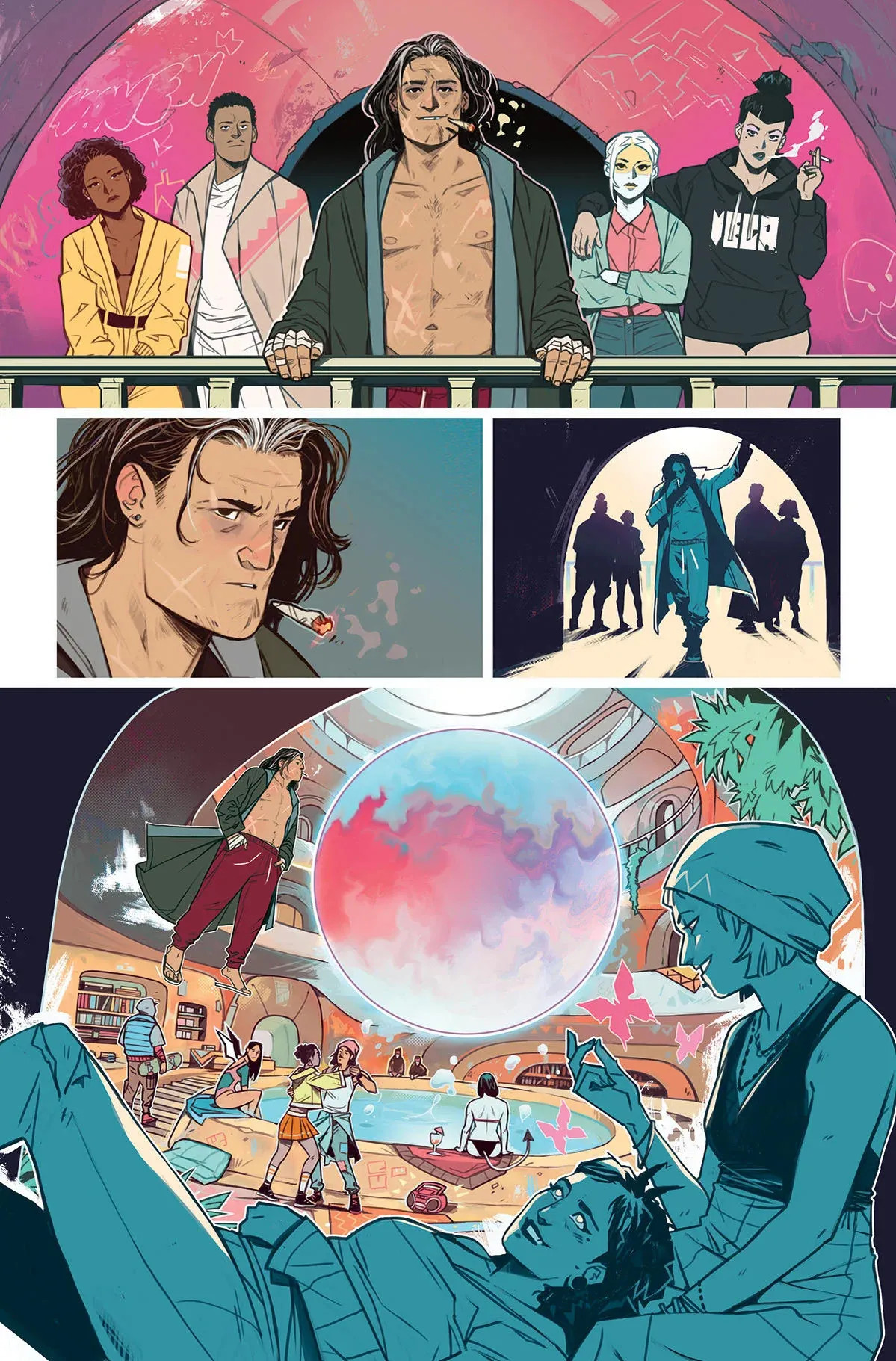
Nevertheless, the broader story — the alternate historical timeline that includes its own Cuban Missile Crisis, its own alien invasion, its own flirtations with extinction-level events multiple times over — is too carefully constructed, and the payoffs in Vol. 3 too dependent on the whole arc, to justify reading these books in isolation. The only responsible recommendation is to start with Vol. 1.
Indeed, read in sequence, The Power Fantasy is a legitimate claim for one of the top three best ongoing contemporary comics series. Vol. 3, in particular, positions it as a contender for graphic novel of 2026, full stop.
This is despite the series also indulging in a Tarantino-esque nonlinear storytelling conceit, full of flashbacks and exposition. And all whilst the main events take place in an alternate reality turn of the millennium.
In essence, the first three volumes form something close to a cohesive whole, and a de facto first season for what Gillen has indicated will be a multi-part narrative of, in a sense, connected maxi-series.
The first has concluded, and Gillen has signaled that issue #17 won’t come out until late 2026 or early 2027. This makes the first 16 issues, and the first 3 trade paperbacks, like a true Book One in the graphic novel epic he’s already set forth.
This is what the medium looks like when two artists at the peak of their craft operate with total confidence in their story. Don’t miss it, but do take your time to savor it.
The Power Fantasy is an ongoing Image Comics series written by Kieron Gillen and illustrated by Caspar Wijngaard, with lettering by Clayton Cowles. Vol. 2: Mutually Reassuring Destruction (collecting issues #6–11) was published September 3, 2025, and is available now at comic shops and major booksellers. Vol. 3: The End of History (collecting issues #12–16) debuted at comic shops on March 25, 2026, with a wide bookstore release on April 21, 2026. A new printing of Vol. 1: The Superpowers (collecting issues #1–5) is available April 15, 2026, from Image Comics and wherever books are sold.
Follow us on X and on Instagram!
Like us on Facebook!
Quinn Quē

Quinn Quē is a storyteller & journalist writing regular interviews, reviews, and features. They've been fascinated with the multidisciplinary arts since a child, particularly film, literature, and television. They love microblogging, so feel free to hit them up on Substack Notes or Tumblr about any recent articles or just to shoot the pop culture breeze!