
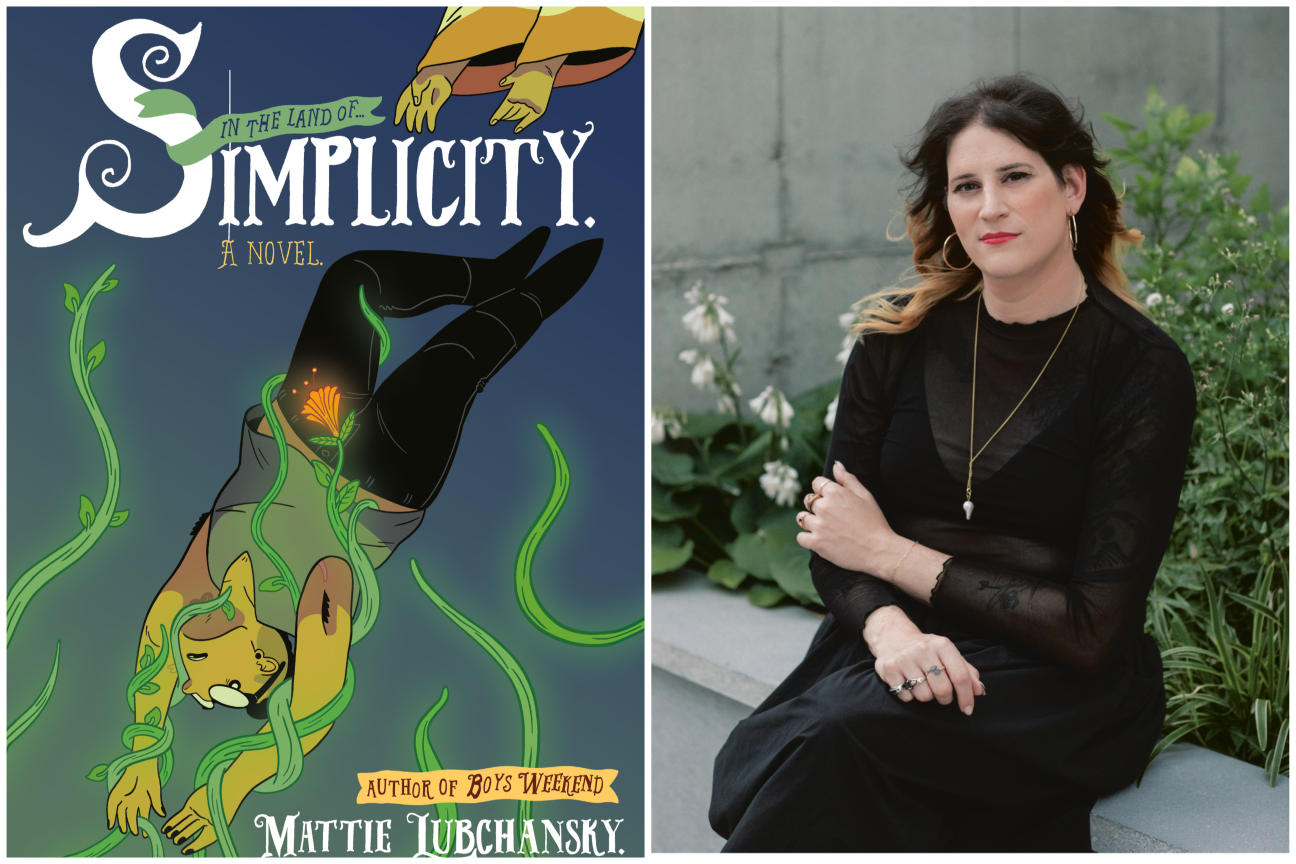
The cartoonist and illustrator, Mattie Lubchansky, isn’t a stranger to creating art that gets people thinking. Their previous books, Boys Weekend and The Antifa Super Soldier Cookbook, don’t shy away from looking at the world from a more critical lens.
Simplicity, Lubchansky’s latest novel, follows a trans academic named Lucius as he is sent out into the wilderness to study a long-standing cult. A journey that forces Lucius to question everything he’s been taught in a tech-centered world when faced with nothing but nature and human behavior.
I spoke with Mattie Lubchansky about the inspiration behind Simplicity and how visual storytelling gives them more freedom to express the ideas they want to write about.

“I feel like ever since I was a very little kid, I was always drawing a lot. My notebooks at school were always more drawings than they were notes,” Lubchansky said.
“Ever since I was very, very young, I was really obsessed with newspaper comics, specifically The Far Side,” they added. “I was really into that, and I watched a lot of cartoons, and I would just always draw when I was watching TV or wherever I was.”
Eventually, they pulled away from art as a creative outlet and pursued an engineering degree because the climate just wasn’t right for indie comics. It was the early 2000s, and graphic novels just weren’t possible career paths.
However, once they graduated, Lubchansky decided to come back to their creative outlet and started what has now morphed into a fully realized career. Lubchansky also discussed the artists who inspired them growing up.
“I wanna say Matt Groening, but not because of The Simpsons, but because of Life in Hell, his old indie comic that he would do for all weeklies in Oregon. I was really, really obsessed with it as a young teenager.”
“It really shaped my drawing sensibility and my humor, and it was really important to me,” Lubchansky said.
“A lot of my science fiction inspirations are not comics, but prose. Specifically like Ursula K. Le Guin and a couple of Margaret Atwood books that I really love, specifically Oryx and Crake,” Lubchansky added.
Switching gears a bit, we discussed Lubchansky’s process for creating characters and capturing moments in their graphic novels, with a particular focus on the approach they used for Simplicity.
“I write first, so I’m kinda like spinning all these people around in my head before I even put pen to paper to design them.”
“You really wanna give as much characterization as you possibly can with the artwork before you write the stuff that isn’t necessarily written. It’s a process of having a sort of vague outline of the people in my brain and then just drawing them over and over and over and over until it feels like them,” Lubchansky explained.
When asked to break down the story of Simplicity itself, Lubchansky was happy to dive into their reasons for certain plot points and settings.
“In the book, there’s a lot of these ecstatic visions that the main character’s having. And it sort of happened the same way to me. I was upstate, I was in nature, I was sitting on a hammock, and I was drifting off to sleep, and I had these really intense visuals of this person experiencing these things,” they stated.
“I didn’t know what they were. I didn’t know what they could be. And I spent a lot of time, like, figuring out, ‘Oh, who’s this guy that I wanna write a book about?’ And it all just kind of spun outta there. And then I started thinking about cults a lot, and I was thinking a lot about utopian separatism.”
“A lot of these utopian communities were founded in upstate New York and western New York. That was sort of like the basis of what they called the burned-over country in the mid-1800s. Which was like this area of great religious revival and also these like pre-Marxist socialist communes,” Lubchansky further explained the reasoning behind choosing the Catskills as the setting of Simplicity.

“The actual town, like the way it looks, is mostly based on my memories of a summer camp I went to when I was a teenager, but that was in Connecticut, in rural Connecticut. A camp called Bucks Rock. It’s where the gong is from as well,” they added.
Overall, Simplicity is a tale about leaving the tech world behind and getting back to a more nature-centered world with both faith and sexual freedom as important tenets of society. This idea originates from Lubchansky’s research into cults and faith-based communes.
“The belief system that I started with was actually the Shakers. The way that the society is set up is sort of, in my mind, a combination of the Shakers and a group of these Utopians that I was just talking about,” Lubchansky said.
“They were the followers of a French thinker called Etan Kabe. And they had a similar thing where it was like, ‘Oh, there was this guy who wrote a book about a utopia.’ They kept trying to found it in America in all sorts of places. They tried it in Louisiana and Texas, and Illinois and Idaho, and later California,” they added. “The stuff about, like, everyone getting together and, like, tearing their shirts off and going crazy, that was a Shaker thing.”
Simplicity is a story that feels both futuristic and timeless at the same time. According to Lubchansky, every bit of that was intentional.
“It was important to me that it was the future because I wanted, I wanted society to be, like, even more broken than it is currently,” they stated.
“The reason that it’s so timeless is the New York City of the 2080s in the book is — so the thing is surveillance, right? It’s like everywhere you go, there’s cameras, there’s advertisements, there’s people, and there’s the cops. Everything you do is controlled,” Lubchansky pointed out.
“It’s very fascist. It’s where we’re going in a lot of ways, or where we’re on track to go. It’s the controlling of people’s time and their activities and the things they like to do. And our bodies, you know, it’s all one big thing that they’re trying to keep people under control.”
Looking to their main character, Lucius specifically, Lubchansky commented on the importance of Lucius being a trans character.
“Bodily autonomy is such a theme in the book, and a wanted connection with one’s own body. So he was always conceived of me to be a trans person. I think there is a fundamental alienation that we suffer, just sort of baked into our lives,” they said.
“But it also allows you to sort of have a different critique of society, I think, or you’ve broken through this membrane that you’re not supposed to. And with that comes a perspective that I just think isn’t necessarily often shared by cis people. I think it’s important for my characters to have this perspective because I do,” Lubchansky concluded.
While there isn’t a straightforward “message” to be found in Simplicity, Lubchansky does hope that readers do take one thing away from reading about Lucius’ adventures.
“I want people to know and to take with them that you can and should fight for things. All we have is fighting for things.”
—
Simplicity releases July 29th wherever books are sold.
Follow us on X and on Instagram!
Like us on Facebook!
Mads Misasi

Mads is a part-time entertainment journalist and full-time marketing content creator. They love reading the latest in Queer novels -- especially romance ones and watching the latest dramas, sci-fi/fantasy, Star Wars, and romcom films/TV shows. They also serve as an associate editor and writer for Tell-Tale TV.