
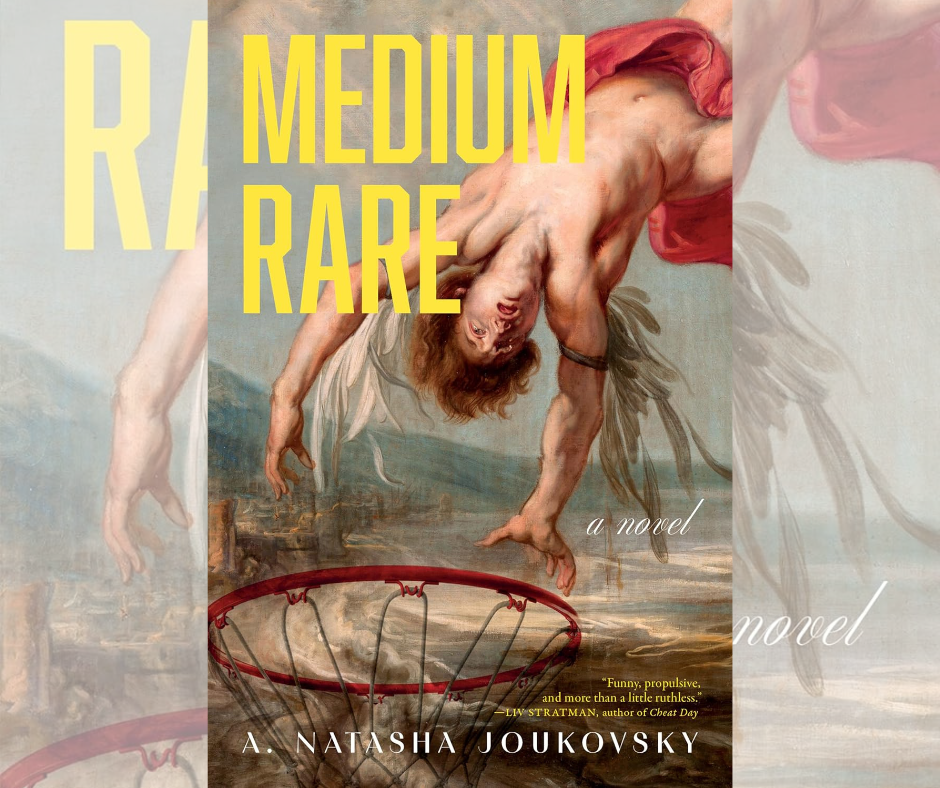
Medium Rare is a 2026 novel by A. Natasha Joukovsky, published by Melville House. The book reimagines the myth of Cassandra through the story of Phil Fayeton, a political operative who fills out a perfect March Madness bracket and wins a billion dollars, only to watch his life unravel through hubris and ambition. It releases March 2026.
With literary novels increasingly turning to sports as metaphor—think The Art of Fielding or End Zone—Joukovsky arrives at the perfect cultural moment. She understands that American obsession with athletics isn’t about the games themselves but what they reveal about luck, skill, and the stories we tell to distinguish between them.
The premise hooks immediately: Phil Fayeton achieves the statistically impossible, correctly predicting every game in the 2019 NCAA tournament. He wins Arun Patil’s billion-dollar prize. What follows isn’t a celebration but a slow-motion car crash narrated by Cassandra, Phil’s fundraiser and the novel’s prophetic observer who sees disaster coming but cannot prevent it.

Moreover, Joukovsky’s greatest achievement is her narrator. Cassandra—cursed to tell truth no one believes—provides the perfect vantage point for examining American self-deception. She watches Phil parlay his windfall into real estate, celebrity, and ultimately a doomed Senate campaign, all while conducting an affair that will destroy him. Her position as both insider and outsider, friend and critic, creates productive narrative tension.
The mythological framework operates on multiple levels. Phil becomes a modern Icarus flying too close to the sun of fame. His swans—purchased as romantic gesture, maintained as status symbols—echo Leda and the transformation of mortals through divine contact. Even the basketball itself becomes a kind of oracle, its bounces determining fate.
Furthermore, Joukovsky demonstrates remarkable range. She captures the granular details of political fundraising, the psychology of NCAA bracketology, the specific aesthetics of ultra-wealthy real estate. The novel moves from DC townhouses to Nantucket estates to San Francisco fundraisers with equal facility. Each setting pulses with authentic life.
The prose walks a careful line between accessible and literary. Joukovsky can construct an elegant sentence without disappearing into stylistic excess. Her descriptions of wealth—the houses, the private jets, the fundraising events—serve character and theme rather than existing for spectacle. She understands that luxury porn isn’t the point; the emptiness beneath it is.
However, the mythological scaffolding occasionally feels heavy-handed. The Cassandra framing device works brilliantly in concept but sometimes becomes too explicit in execution. We don’t always need the narrator explaining her prophetic role when the dramatic irony already accomplishes that work.
The pacing moves deliberately through Phil’s rise and fall, structured around the basketball season and political calendar. This creates natural momentum but also some unevenness. The early sections establishing Phil’s world feel essential. The middle sections tracking his campaign sometimes sprawl. The final act—his catastrophic fundraiser and fatal car crash—delivers devastating payoff.
Nevertheless, the novel’s examination of American delusion feels searingly relevant. Phil believes his bracket success represents skill rather than luck, that his wealth makes him deserving, that he can outrun consequences. He’s not uniquely American in these beliefs, but he’s quintessentially so. Joukovsky dissects this psychology without lecturing.
In addition, the supporting cast enriches rather than clutters. Raleigh, Phil’s wife, embodies Southern politeness as both strength and prison. Sunny Sanders represents the affair as distraction and self-destruction. Arun Patil mirrors Phil’s ambition through different means. Each character serves the larger examination of American aspiration and its costs.
The basketball itself becomes character. Joukovsky clearly understands the sport, the culture around March Madness, the specific dynamics of Virginia’s pack-line defense under Tony Bennett. These details ground the novel in specificity while supporting its broader metaphorical ambitions. The 2019 tournament—Virginia’s redemption after losing as a 1-seed to a 16-seed—provides perfect narrative symmetry.
Does Medium Rare reinvent the sports novel or create something radically experimental? Not quite. The Icarus arc has appeared in countless American narratives from The Great Gatsby to There Will Be Blood. Joukovsky’s contribution achieves partial success in execution and contemporary resonance, but does not fully hit the pure formal innovation aspirations it seems to seek.
What she accomplishes, however, is remarkable work that takes its themes seriously without sacrificing narrative pleasure. The book engages genuine questions about luck versus merit, the relationship between wealth and worth, the American capacity for self-mythology. It does so through propulsive storytelling that never feels didactic.
For readers who appreciate novels that examine contemporary American life through mythological frameworks, Medium Rare delivers. For those seeking breakneck thrillers or experimental narrative structures, this may feel too measured, too literary. The novel knows what it wants to be—a contemporary myth about American ambition—and executes that vision with intelligence and style.
Ultimately, Joukovsky’s second novel confirms her as a significant voice in contemporary fiction. Medium Rare demonstrates impressive range from her debut The Portrait of a Mirror, tackling different subject matter while maintaining thematic continuity around self-perception and social performance. In a literary landscape often content with derivative ambition, that’s worth celebrating.
Medium Rare releases March 2026, published by Melville House.
Follow us on X and on Instagram!
Like us on Facebook!
Quinn Quē

Quinn Quē is a storyteller & journalist writing regular interviews, reviews, and features. They've been fascinated with the multidisciplinary arts since a child, particularly film, literature, and television. They love microblogging, so feel free to hit them up on Substack Notes or Tumblr about any recent articles or just to shoot the pop culture breeze!