

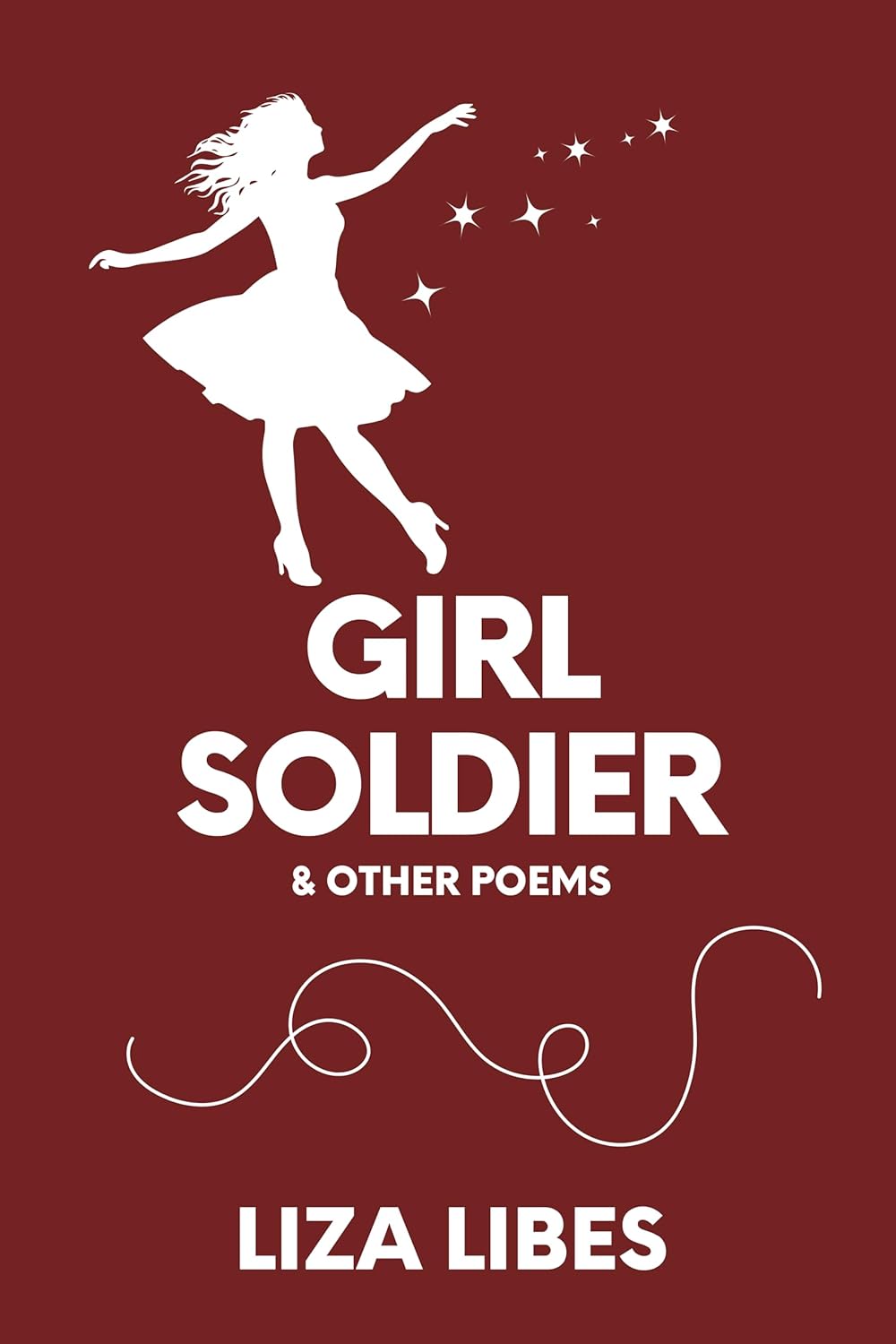
Girl Soldier & Other Poems is a 2025 poetry collection by Liza Libes (LEE-zah LEE-bess), who holds degrees in English and Comparative Literature from Columbia University.
The collection spans 56 pages, exploring themes of Jewish identity, romantic loss, and coming-of-age in New York City. Published independently, it marks Libes’ debut as she transitions from academic study to public-facing literary work.
Judging poetry remains one of the most contentious tasks in literary criticism. Girl Soldier embraces this difficult liminal space.
The collection operates as an eclectic mix of writing styles and approaches, ranging from narrative verse to more lyrical moments. Libes clearly isn’t interested in adhering to a single aesthetic or satisfying purist expectations about what poetry should accomplish.
In fact, the opening poem “Yellow” establishes this narrative-forward approach immediately. The piece tackles campus antisemitism through a Passover Seder disrupted by news of protests. The subject matter carries genuine emotional weight and urgency.
The treatment leans heavily on narrative: “Someone complained that Max was in the game / But he was not yet a Bar Mitzvah, so it was conceded, / And anyway he lost (likely by his own design).” The specificity and autobiographical detail prioritize accessibility over compression. For readers seeking traditional lyric density, this may feel prose-like, but narrative poetry has its own legitimate tradition.
Similarly, “Farmer’s Market” continues this confessional, story-driven mode. The speaker reflects on aging and motherhood through market imagery. “I never liked to haul a melon / from the market— / instead, I’d gather raspberries and currants,” Libes writes, grounding abstract anxieties in concrete details.
The title poem “Girl Soldier” extends this approach across multiple stanzas. The piece explores gender, militarism, and relationship dynamics through fragmented memories. “When we were as wooden leaders / Done up in an antique theater / Dangling from a plus-sign stick,” it opens, establishing a surreal tone that persists throughout.
Furthermore, “Sunday Evening Paper Boy” exemplifies the collection’s extended narrative style. Spanning multiple sections, the poem traces a relationship from meet-cute to bitter ending. The specificity is notable: “Red stripes and / Meditations on a branch of tea / Lattes that we could not locate / In the cafe of a bookstore.”
By contrast, “Rousseau” and “Princess Shulamith” mine personal relationships whilst employing near rhymes and bit of a more rhythmic quality. The former mourns a fading romance through musical metaphors. The latter interrogates gender roles and biology with philosophical references that showcase Libes’s Columbia education.
However, “Horoscope” demonstrates both the collection’s strengths and weaknesses. At over 80 lines, the piece narrates a toxic relationship through astrological imagery.
It is rambling in parts, and its mixture of free verse and lyricism doesn’t quite work, despite genuine intensity from lines like… “F*ck me underneath the rainbows / Where the leprechaons blush red and white / Bemoaning our depravity.”
Indeed, the length and uneven discursive quality in the overall volume can test patience. The line breaks often follow natural speech rather than creating deliberate tension. For readers who value compression and rhythmic sophistication, this extended confessional mode may feel indulgent.
On the other hand, “The Bostonians” offers more restraint. The shorter piece captures a moment of parting with economy: “When we found ourselves alone that day, / I had a premonition that I should have waited / For that plane.” The compression serves the emotional content effectively.
In an interesting contrast, “The Crematorium of Art” takes a more polemical turn. The piece critiques contemporary literary and media politics with lines like “These tyrants who uproot the pulpits of autonomy, / And replace the kingdom of sagacity / With a measly puppet state.” Whether this rhetoric succeeds depends on the reader’s tolerance for direct political commentary in verse.
Meanwhile, “Indigo Arcadia” offers one of the collection’s more lyrical moments. “Here there are no limits / On the spattering of youth; / There is no time where Beauty grows extinct, / For Beauty is illimitable,” Libes writes. The language reaches for compression and symbolic resonance rather than narrative specificity.
Then “Stars” returns to extended narrative mode, tracing another relationship across multiple stanzas. The piece moves from “Crooked eyeballs from across the room” through various New York scenes to a wedding fantasy that never materializes. The autobiographical detail remains central throughout.
Finally, “Astronaut” closes the collection with notable restraint. At just 14 lines, the piece achieves metaphoric coherence: “An astronaut in outer space / Loses out on sanity / Orbiting the universe / Somewhere around Saturn’s rings.” The central conceit—emotional isolation as orbital drift—functions symbolically in ways the longer narrative pieces sometimes resist.
Throughout, the collection reveals strong literary awareness through references to Rousseau, Nabokov, Kantian ethics, and East of Eden. Libes clearly possesses intellectual range and cultural literacy. How well it enhances or distracts from the proceedings is an open question.
Additionally, the thematic coherence deserves acknowledgment. Jewish identity, romantic disappointment, artistic ambition, and New York City life weave through these pieces consistently. For readers who value thematic unity over formal experimentation, this approach may prove satisfying.
Still, readers with strong preferences for rhythmic density, sonic architecture, or linguistic compression may find much of the collection frustrating. The narrative sections can feel discursive, and line breaks don’t always create the tension that distinguishes poetry from lineated prose. That’s a legitimate response to work that prioritizes other values.
Ultimately, Girl Soldier & Other Poems works best when approached without rigid expectations. It’s an eclectic debut that values emotional honesty over formal innovation or acoustic sophistication. Some pieces justify their poetic treatment more successfully than others, but the collection represents a sincere artistic effort.
Libes has stories worth telling and the courage to tell them plainly. Whether future work develops stronger rhythmic patterns or tighter compression remains to be seen. That tension itself reflects larger ongoing debates about poetry’s purpose and possibilities.
For now, the volume simply presents itself and dares the audience to decide.
Girl Soldier & Other Poems is available now via Amazon and independent booksellers.
Follow us on X and on Instagram!
Like us on Facebook!
Quinn Quē

Quinn Quē is a storyteller & journalist writing regular interviews, reviews, and features. They've been fascinated with the multidisciplinary arts since a child, particularly film, literature, and television. They love microblogging, so feel free to hit them up on Substack Notes or Tumblr about any recent articles or just to shoot the pop culture breeze!