
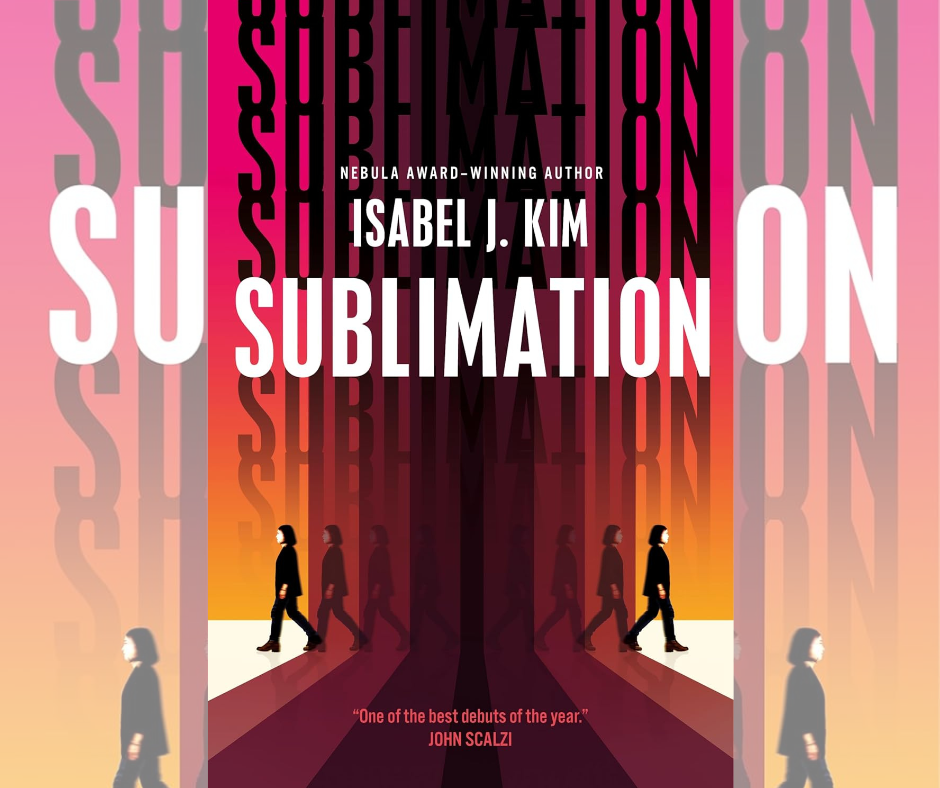
There’s a scene early in Sublimation, Isabel J. Kim’s debut novel, where two women sit across from each other, share memories, up to a point, and feel nothing but dread. That’s the engine; the whole machine.
Based on her own short story “Homecoming is Just Another Word for the Sublimation of the Self,” the concept Kim is working with is deceptively simple and philosophically vertiginous: emigration literally splits a person in two.
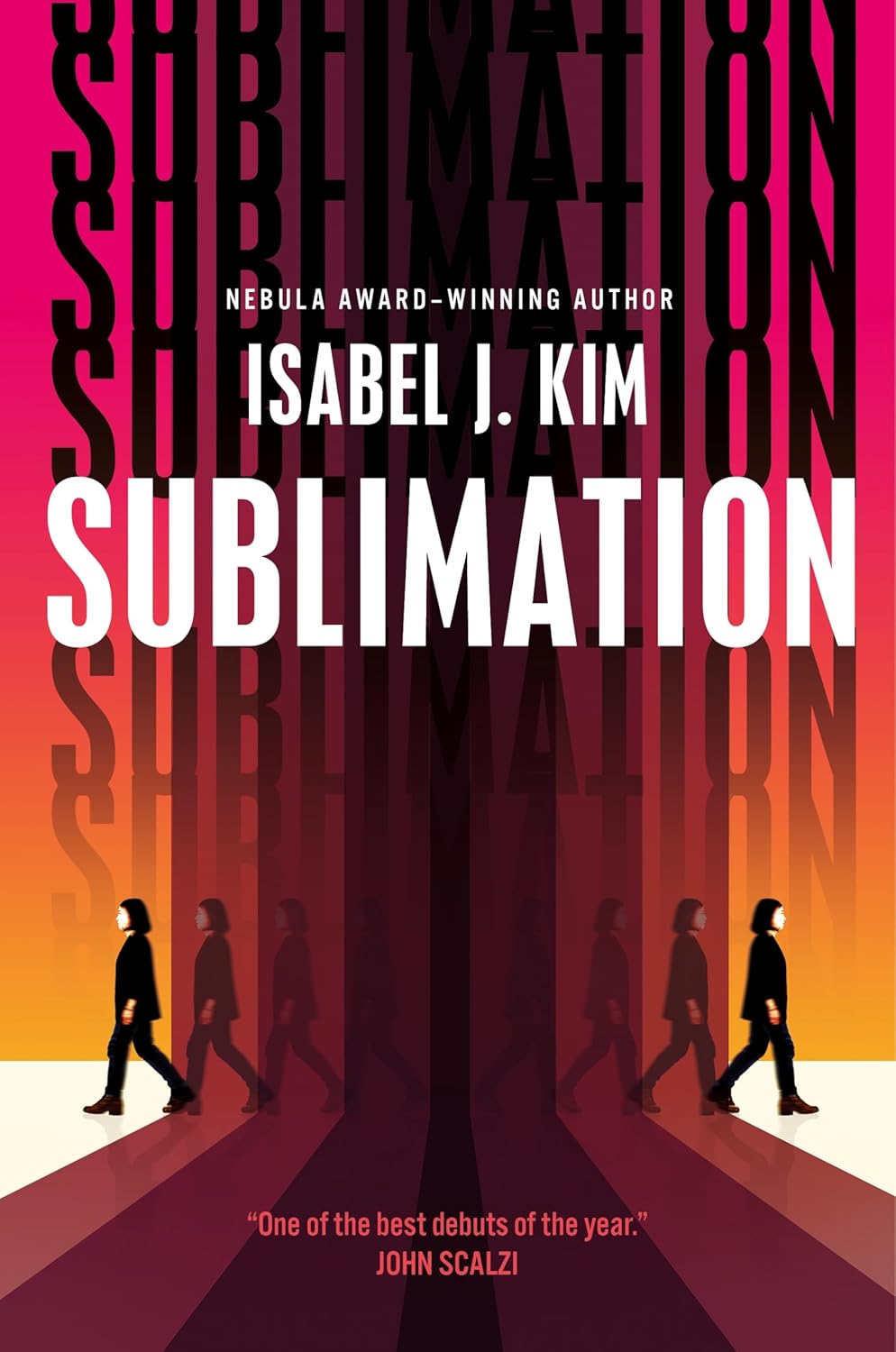
One instance crosses the border; one stays behind. They share a past up to the moment of departure, then diverge into entirely separate lives, separate selves, separate people—connected only by the memory of who they used to be before the border cut them apart.
It’s one of the top five best high-concept speculative premises in the 2020s. Easily, and not for lack of competition.
Rose and Soyoung are the same woman. Rose left Korea at ten and never looked back while Soyoung stayed. Their grandfather’s death forces the reunion neither wanted, and from that grief-soaked meeting, the novel’s actual stakes emerge: Soyoung wants what Rose has, and she’s willing to take it without consent.
Reintegration—the act of the two instances merging back into one, achievable through physical contact—doesn’t require both parties to want it. That’s a hell of a premise for a thriller. Unfortunately, Kim only halfway commits to it.
The novel’s first half is where it really sings. Kim moves between second-person and third-person narration with precision and nerve, creating a blurring effect that mirrors the identity crisis at the book’s core.
When the narration addresses the reader as “you,” it isn’t just a stylistic choice, it’s a philosophical argument about the unstable relationship between self and observer. The prose has a lyricism that doesn’t curdle into preciousness, which is harder than it sounds.
Furthermore, the worldbuilding is deployed with admirable restraint. Kim doesn’t dump exposition. She threads the rules of instancing through the narrative in small, digested pieces.
How it’s worked historically, what it means legally, how America itself was populated by instances granted citizenship in 1776. The novel has the good sense to treat its readers as adults.
The secondary pair, Yujin and YJ, does a lot of heavy lifting thematically. Where Rose and Soyoung are estranged, Yujin and YJ are coordinated, strategically synchronizing their lives, gaming out futures, playing League of Legends together across the Pacific.
Their relationship makes the concept warmer and stranger simultaneously. Yujin, specifically, is the character one will leave wanting more of.
However, the novel wobbles when it tries to become a techno-thriller. The back half involves a tech company sitting on game-changing instancing research, corporate whistleblowing, and geopolitical stakes—none of which carry the visceral urgency the personal story had built. The threat is legible but not quite fully felt.
Soyoung’s motivations, which should be the spine of the thriller plot, remain underexplored. The novel tells us she wants something, but doesn’t quite make us understand the need the way we might with better development. Not a fatal flaw, but one which costs her the reader’s investment in the climax.
The romance subplot, similarly, arrives and concludes in a rush. It’s not bad, just abbreviated, like Kim ran out of novel before she ran out of story.
Nevertheless, the novel as a whole earns its ambitions more than it doesn’t. Kim is asking what it means to become a different person without anyone’s permission. What a life left unlived owes to the one actually being lived.
Whether the self that goes away and the self that stays behind are even, in any meaningful sense, the same person anymore. These are not easy questions, and she doesn’t give easy answers—which is the right call.
Kim has a gift for using historical specificity to anchor the speculative, and those moments are where the book feels most like the short story it grew out of, just stripped of filler. And turned into something that’s burning at its center.
Ultimately, Sublimation is a debut that’s smart beyond its years, more ambitious than it is fully realized, and still more worth reading than most peers. Several finished novels sitting on shelves right now can only wish they were this good. Kim is the real deal. Watch this writer.
Sublimation is a debut literary speculative fiction novel by Isabel J. Kim, published by Tor Books. It is 368 pages and releases June 2, 2026 in the United States (July 9, 2026 in the UK via Picador/Pan Macmillan). It is available for pre-order now at major retailers.
Follow us on X and on Instagram!
Like us on Facebook!
Quinn Quē

Quinn Quē is a storyteller & journalist writing regular interviews, reviews, and features. They've been fascinated with the multidisciplinary arts since a child, particularly film, literature, and television. They love microblogging, so feel free to hit them up on Substack Notes or Tumblr about any recent articles or just to shoot the pop culture breeze!