
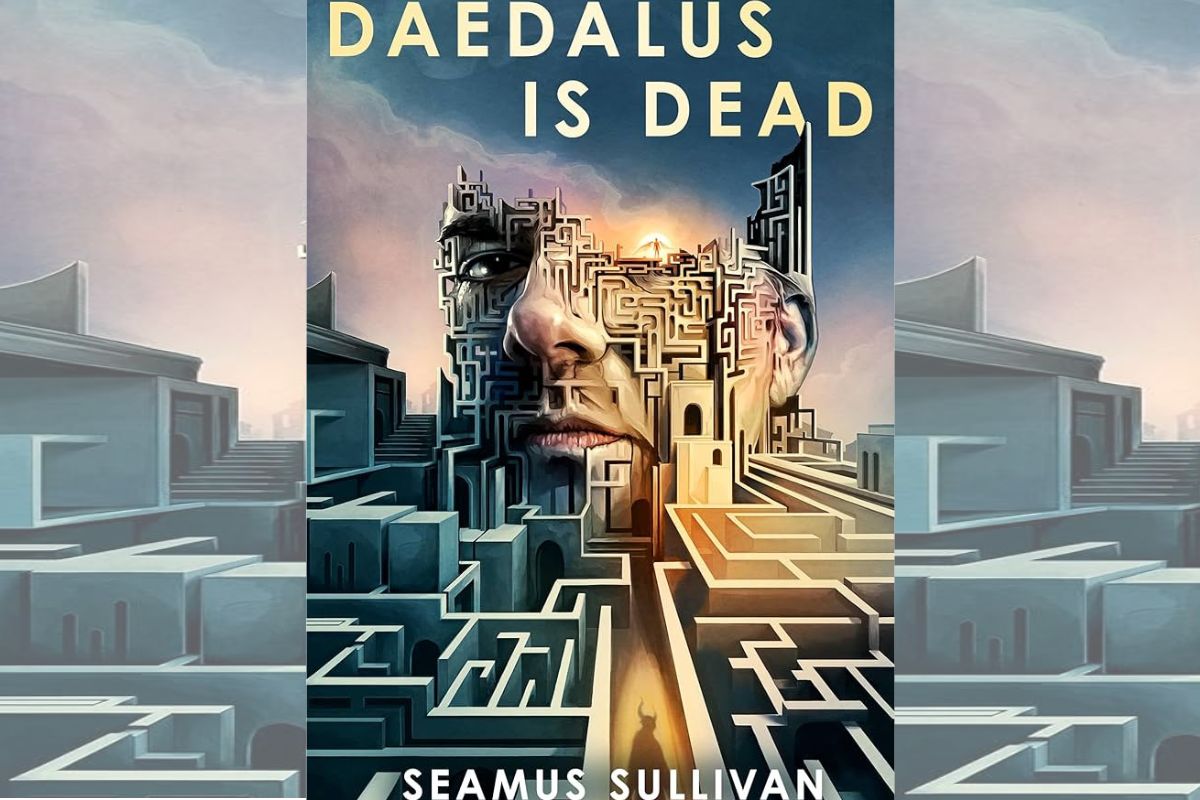
The debut novella of author Seamus Sullivan, Daedalus is Dead, reframes the story of Daedalus and his son, Icarus.
From the first page, the writing style and choice of tense prove to readers that this is no ordinary retelling. Daedalus, architect and builder of the infamous Labyrinth, is talking directly to Icarus; he’s narrating the story to his son. At the same time, it’s ingenious because we, as the reader, seem to be addressed through the use of the word ‘you.’
As the title suggests, not only is Daedalus dead, but he’s in Hell, commonly referred to in Greek myth as the Underworld. Now that he’s dead, he’s trying to reunite with his son, make amends, and find answers to burning questions from his life.
This novella jumps backward and forward through time, allowing for good pacing and a swift read that can be accomplished in one sitting. It makes the plot move faster, but doesn’t allow for the most casual reading experience. Readers need to be on their toes to piece the story together.
The most famous aspects of Daedalus’ myth are all told in the context of how Icarus is the common thread throughout his father’s life.
Full of beautiful and lyrical descriptions, Daedalus is Dead is an original and inventive retelling. Daedalus is clever, reminiscent of the wily Odysseus, another famous character from Greek myth.

Through the time jump format, the timeline of Daedalus’ life is laid bare. Seeking fame with his remarkable architectural skills and unmatched knowledge, he travels to Crete to serve King Minos and build a glorious new kingdom for him. Minos, realizing Daedalus’ talent, selfishly keeps him as a captive; he cannot escape, and his talents are now for the evil king only.
Daedalus grows close with Naucrate, a fellow slave, and together they have Icarus. Naucrate eventually escapes the island kingdom of Crete to return to her homeland, leaving Daedalus to raise Icarus on his own. The bond between father and son is strong, and Daedalus loves Icarus more than anything.
At this point in the story, the infamous Minotaur finally comes into play. King Minos’ wife Pasiphae is cursed by the gods and bears a son that is half-human, half-bull. He is named Asterion, though it is Minos who calls him the Minotaur.
Minos tasks Daedalus with creating a nursey for Asterion, as it becomes clear he is a dangerous child. Creating and building the Labyrinth, a maze with no real beginning or end, takes a toll on Daedalus, as well as his builders, many of whom lose their lives in the process. Daedalus’ relationship with his growing son becomes strained as well; he spends all his time working.
Before the paranoid king can turn on Daedalus and throw him to the Minotaur, Daedalus devises an escape plan for himself and Icarus. Many may know the famous story of Daedalus’ and Icarus’ flight to escape Crete. Daedalus painstakingly builds a set of wings for himself and his son to fly away, but he warns Icarus not to get too close to the sun because its heat will melt the wax holding the winged contraption in place.
Here is the turning point in the story. Icarus, enjoying his freedom, flies higher and higher, ignoring the pleading from his father, who is too slow to catch up or stop him. He plummets into the sea and to his death.
Daedalus is devastated. How can he go on without his beloved boy? He realizes he has no choice and tries to rebuild his life, honoring Icarus’ memory until they are reunited in death.
Icarus continues to haunt him, even after Daedalus dies. Once Daedalus passes from this life and enters Hell, all he can think about his finding his son. But Icarus cannot–or does not wish to–be found.
Daedalus begins to question Icarus’ motives. Did he fly too close to the sun on purpose?
Was he trying to escape his father? Did he see something evil in Daedalus or suspect he was not a good man?
Here, the novella really turns on its head. We start to realize, bit by bit, that Daedalus may not be a good person at all. We can’t escape the feeling that he wasn’t originally telling us, or Icarus, the entire truth of his life, making us question the entire story up until this point.
Daedalus perceives this, too, admitting he may not be remembering his life in the most honest fashion, and he vows to make amends. But will it be enough to allow him to see Icarus again?
As the story comes to a close, one detail is revealed from Daedalus’ life that nearly spoils the book entirely. It’s difficult to reconcile the thrilling aspects of the story with this terrible plot twist, in which someone is betrayed by someone they love, that there is no justification for.
Sullivan seems to be playing mind games with readers, twisting their expectations for unnecessary shock value. If the author wanted to change perceptions of Daedalus, he could have done it in countless other, less harmful ways.
Aside from this detail of the ending, Daedalus is Dead is well done and an inventive retelling that focuses on characters not written about in many modern retellings. Many famous characters from myth appear in the story, both while Daedalus is alive and in Hell. They’re all well-written and fully formed. Ariadne, daughter of Minos, is one particular standout.
What Daedalus is Dead is not, however, unlike many retellings of today, is a feminist retelling. This is a story of a father trying to find his son; it revolves around the theme of fatherhood and how it can be warped. Most other popular retellings focus on women of Greek myth, so the target audience is a bit unclear, but it’s enjoyable and humorous, even if some readers cannot personally relate to the dynamics of father and son.
For such a short novel, it packs a punch. There’s never a dull moment, and there are subtle references to other myths that not everyone might catch. It does leave a few unanswered questions, as some things are not clearly explained, like the rules of the Underworld.
Daedalus is Dead is one of those books that may require multiple re-reads to truly appreciate and understand all its nuances. As twisting and turning as the Labyrinth, it’s a worthy, solid four stars.
Daedalus is Dead will be available on September 30th wherever books are sold.
Follow us on X and on Instagram!
Like us on Facebook!
Learn more about Eulalie Magazine here.
Amanda Larch Hinchman

Amanda Larch works as a writer and editor when she’s not in the middle of a good book. Learn more about her work and view her portfolio at www.amandalarchwriter.com/ and keep up with her on Goodreads @_groovyginger_.