
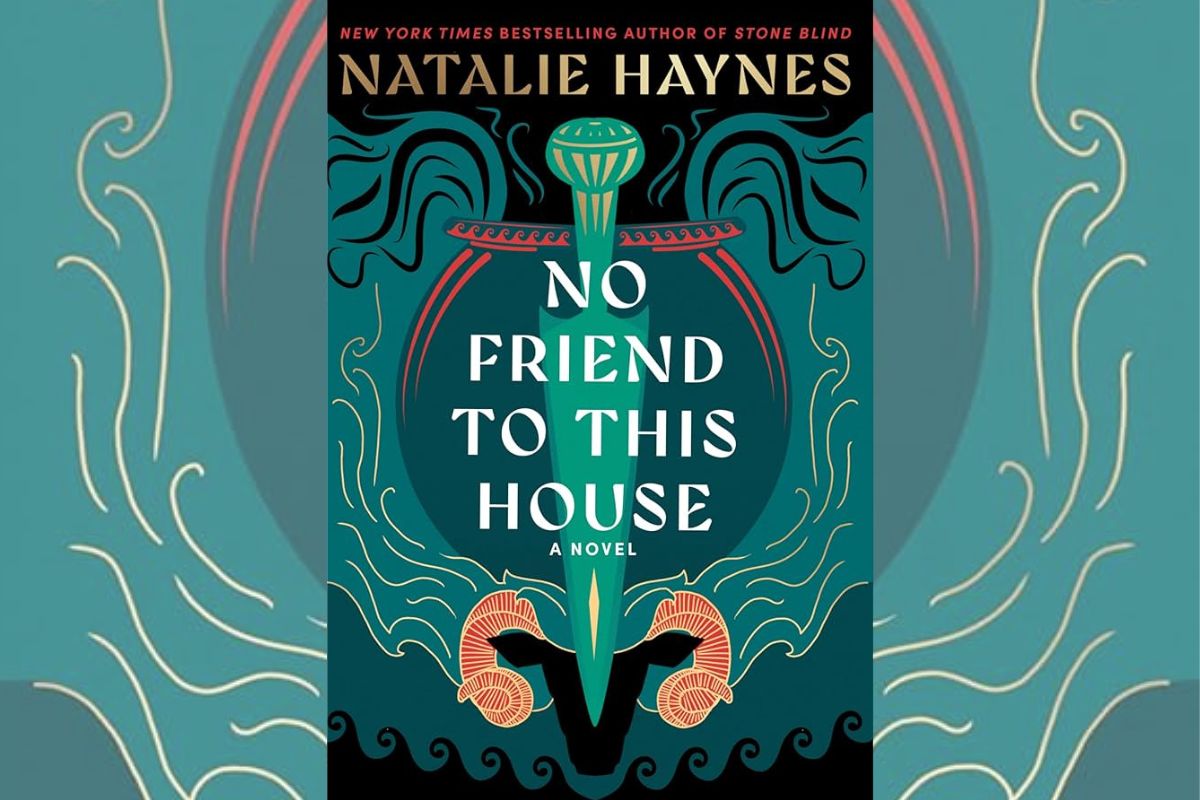
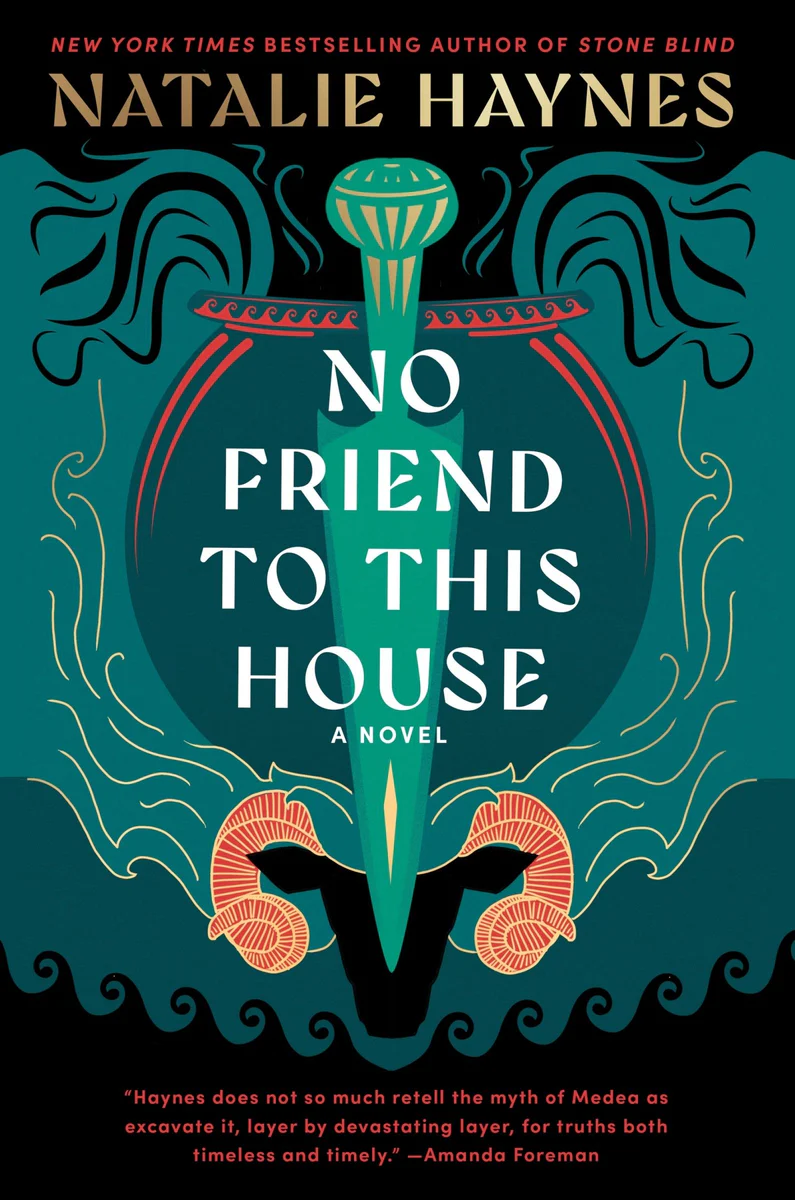
Natalie Haynes is perhaps the foremost writer of Greek myth retellings right now. Published earlier this year in the U.S., her latest novel No Friend to This House reframes not only the story of Medea, but also the tales of Jason and the Argonauts.
Weaving a complete story through the eyes of women, Jason and his quest for the Golden Fleece is laid bare and related by various female characters, ranging from Hypsipyle and Alcimede to Kleite and Theophane. If these women don’t sound familiar, it’s because, more often than that, they’re left out of the tale.
That’s why Haynes brought them to the forefront.
Nearly everyone is somewhat familiar with the Golden Fleece and the Argonauts. Haynes, however, isn’t interested in rehashing the same glorious exploits of these would-be heroes.
After his uncle usurps his father, the king of Iolcus, Jason embarks on a quest to the faraway land of Colchis to retrieve the Golden Fleece, a legendary artifact thought to bring luck and fortune to whoever, and whichever kingdom, possesses it. With the fleece in hand, he believes he will restore the balance and rule the kingdom.
His uncle is sure the quest will kill him first.
Named after the Argo, the ship that will take them on their sea voyage, the band of heroes themselves are not the central focus. Heracles, otherwise known as Hercules, is a popular figure from Greek myth who joined in the Argonauts’ voyage for a time. In this book, he’s little more than a footnote.
That’s the brilliance of Natalie Haynes. She successfully makes readers care more for the women of myth than the well-known male characters.
Jason’s long quest, full of adventure and unforgettable characters, leads to Medea’s homeland of Colchis, the residence of the Golden Fleece. No Friend to This House can really be broken into two parts: before Jason meets Medea and after they begin their ill-fated love affair.
Medea’s father, Aietes, is nothing short of a tyrant. He wants to hold onto his treasure, and Jason cannot hope to claim the fleece without Medea’s help.
A princess as well as a powerful witch, Medea is an acolyte of the goddess of magic and darkness Hecate. Thanks to meddling from the gods of Olympus, Medea falls violently in love with Jason at first sight. She’s a pawn in the gods’ games and helpless to change her fate.
In love and fearful for Jason’s death, Medea knows she cannot watch him die. She will help him through the dangerous and seemingly impossible tasks set before Jason by Aietes in order to claim the fleece. She will do so with her mastery of magic and with the blessing of Hecate, her beloved goddess.
Jason and Medea meet in secret, scheming and concocting a plot to protect Jason as he battles fire-breathing oxen and an army of the dead. Before executing their plan, Jason swore with honeyed words that he would bring Medea to his home as his wife.
With her help — indeed, Medea does much of the heavy lifting to retrieve the fleece — Jason finally has what he came for. Together, they flee Colchis, as Medea knows she has betrayed family for this man.
In a rush, with casualties and condemnations along the way, and the famous Circe even making an appearance, Jason, Medea, and the Argonauts arrive triumphant in Iolcus. Jason soon discovers, though, that it won’t be so easy for him to reclaim the throne.
Once again, Jason needs Medea to accomplish his plans and uses her magic against her, making her commit heinous crimes in his name while taking all the blame away from him. The pair are then exiled, wandering throughout Greece for years before settling in Corinth.
Along the way, they grow their family as Medea gives birth to Jason’s sons. Yet he increasingly uses her foreignness against her, and as he sees an opportunity for wealth, power, and higher status in Corinth, Jason even begins to deny they were properly married in the first place, claiming that, as she is a non-Greek, their marriage is invalid.
Jason continues in his preparations to marry the princess of Corinth, all while Medea remains in their home, fretting over her safety and the future of her children. Here the story builds to its climax.
Medea, her love and hatred for Jason in equal measure, takes matters into her own hands. She cannot allow him to disgrace her and abandon his children.
What she chooses to do next could destroy her nonetheless. No Friend to This House concludes with multiple deaths, heart-pounding drama, and the feeling that justice and revenge have both been served.
No Friend to This House does not shy away from the violence of myths. It’s unflinching in that regard. It makes readers question the essence of a hero.
In Haynes’ world, Jason makes for the perfect villain. Indeed, the book’s title comes from a line from a play by the ancient Greek writer Euripides talking about Jason — not Medea, as some may presume. Jason is calculating and uses his charms to get ahead, no matter how he hurts or harms others.
He thinks only of himself. He is no true friend to the house of Medea and her children.
While these two characters make up much of this book and its plot, this myth retelling is about so much more than Jason and Medea.
One common theme throughout is how much of a role women — both mortal and immortal — play in this story. At the same time, it tells how little Jason regards women even though he has them to thank for his so-called heroic deeds.
Broken up into short chapters and constantly switching points of view, this book is dizzying, like watching a tennis match. And Haynes uses conventional and unconventional characters to tell this tale. Crows, doves, nymphs, goddesses, the Argo itself — all are utilized in a cohesive narrative.
These minor characters, some of whom are only with us for a chapter are two, are some of the most memorable. Haynes gives insights into numerous other myths, like the moon goddess Selene and various minor queens throughout Greece, and introduces the origins of the Golden Fleece, how it belonged to a beautiful ram, and has been reduced, over the centuries, to little more than a lifeless object and magical artifact.
She is determined these characters and their stories will not be forgotten.
Additionally, many characters address us directly, making the audience feel like an active part of the book and the brilliant story within. We feel included.
Because it’s told in such a unique format, there’s really no time or space for much world building. It’s character- and plot-heavy, and it works without a doubt, but Haynes didn’t slow down to parcel out too many details about palaces, landscapes, or other settings.
Combined with the readers’ imagination, her quick witted writing doesn’t suffer, and it’s fairly easy to imagine these places as the author intended, but building upon these locales of legend would have only added to this novel.
Haynes’ love for Euripides and the original, ancient source material where Jason’s and Medea’s stories first appear, is evident throughout the novel. A celebrated classicist, Haynes knows her stuff, and her author’s note is a must read, too.
The book certainly does not come across as high brow, nor it it isolating, but it helps if readers have a bit of background going in.
The ending is satisfying. No spoilers here, but for those who know the tragic fate of Medea and her sons, Haynes provides adequate justification and a glimmer of hope. There is one magnificent twist that feels like a knife wrenching its way into the story. It’s sudden, it’s brilliant, it’s simple.
No Friend to This House is full and rich, yet it’s light enough for a quick, fast paced and immersive read. Haynes approaches retellings with a no stone left unturned attitude. She explores all angles.
It’s come to be her signature in novels like this, as well as A Thousand Ships, about the women of the Trojan War, and Stone Blind, a retelling of Medusa.
No Friend to This House is available now wherever books are sold.
Follow us on X and on Instagram!
Like us on Facebook!
Amanda Larch Hinchman

Amanda Larch works as a writer and editor when she’s not in the middle of a good book. Learn more about her work and view her portfolio at www.amandalarchwriter.com/ and keep up with her on Goodreads @_groovyginger_.