
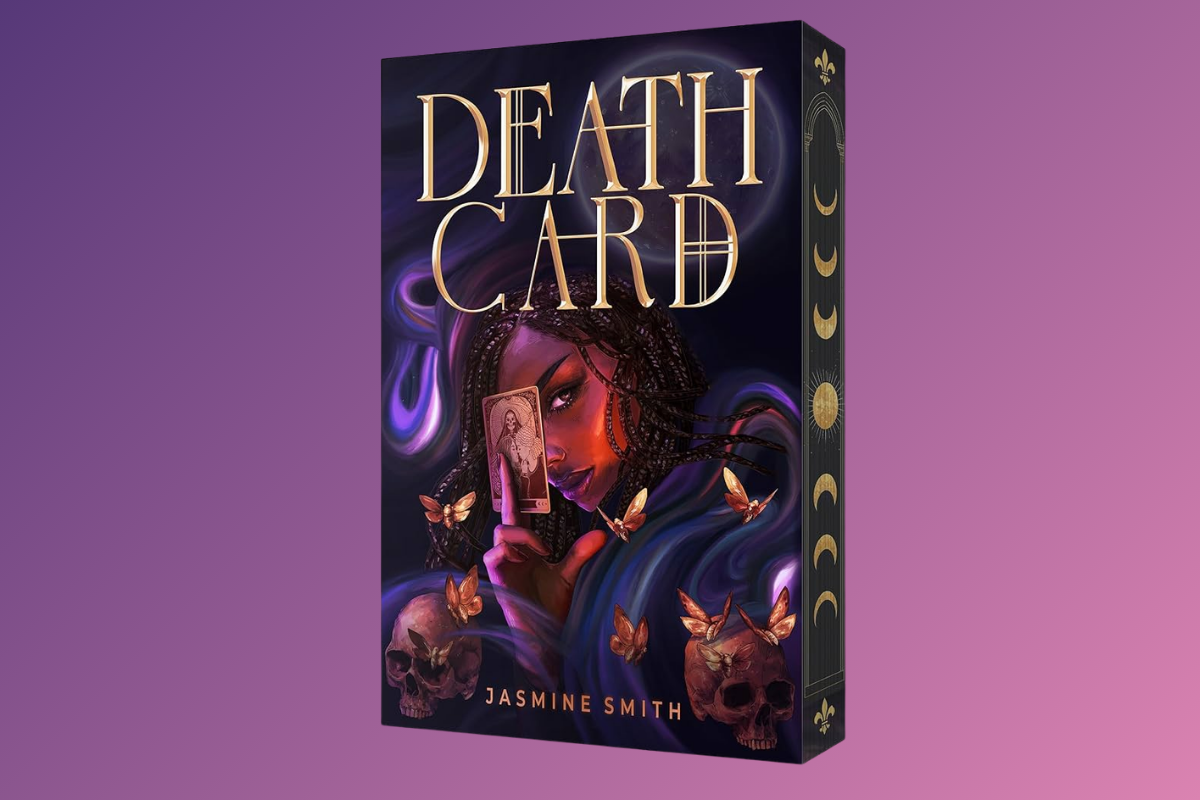
In Death Card, 18-year-old Mikaela Broussard is a witch among a long line in her family.
Poised to be the next Witch Queen after the death of her grandmother, Mikaela struggles with her lack of formidable powers. Mikaela’s life takes a turn for the worse when witches start showing up dead and with their magic stolen.
If that wasn’t enough, after Mikaela does a tarot reading for cute stranger Joelle, she sees a vision of Joelle stabbing her to death.
Now, Mikaela must investigate these developments. And throughout her journey, she must learn to come into her own and figure out her feelings for Joelle when they seem destined for destruction.
Death Card boasts an interesting premise, and it’s full of potential, from the matriarchal witch line to the Queer romance between Mikaela and the girl destined to kill her.
Unfortunately, it falls short on execution.
Despite being a fantasy, the book doesn’t explore the magical system in this world. We never learn, for example, how witches cast spells, why they follow a matriarchal line, or how they find fellow witches when they disguise themselves in the mortal world.
This makes it hard to invest in Mikaela’s struggle with her own power since Death Card focuses so little on the world-building. Despite crafting a fascinating concept, it’s hard to understand how or why Mikaela struggles with her powers. It makes her character development fall flat as a result.
The novel also struggles to convey Mikaela’s character development realistically because it relies on showing over telling. Too many times, Mikaela describes her grief, anger, or frustration by stating how she’s feeling, which takes away from her feeling like an authentic character.
Because of this, she comes across as suddenly being more confident in her power and herself as the novel progresses, lacking the believable buildup required to see her as a fully developed character. Despite being the protagonist, Mikaela is a difficult character to get invested in.
Joelle also lacks believable character development, despite being Mikaela’s love interest.
She shows up sporadically throughout the book, never enough for us to really get to know her. Again, the novel relies on telling over showing, having Mikaela tell us the traits she sees in Joelle and likes, but never showing us.
Joelle’s many absences from the novel make it hard to believe her relationship with Mikaela progresses as far as the novel tells us. Despite their relationship being mentioned first in the book’s official summary, they don’t spend much time together, making their relationship feel forced.
The other characters are developed even less than the leads. Mikaela has some fellow witch friends, is enemies with the daughter of the man running for mayor against her grandfather, and has a twin brother, Orion. They mostly show up as side characters, with Orion getting slightly more attention as Mikaela’s brother, but he never fully gets a chance to develop as a character.
Finally, Death Card struggles with trying to balance multiple storylines and never fully delving into them. There’s the mystery of witches dying and losing their magic, Mikaela investigating Joelle and why she’ll kill her, and a side plot of Mikaela’s grandfather running for mayor.
These three storylines feel like separate threads, never connecting until near the end of the novel. At the worst of times, it feels like the novel doesn’t know what it wants to focus on most. You’re left feeling that all plot lines are rushed and underdeveloped.
Death Card lacks the required, in-depth world-building that makes a great fantasy, doesn’t develop the main romance, and struggles with too many plot lines that don’t feel interconnected. While it’s nice to see Black and Queer representation within the story of a character coming into their own, the execution falls flat.
—
Death Card is a YA fantasy novel by Jasmine Smith, published by Putnam Young Readers. It releases August 11, 2026.
Follow us on X and on Instagram!
Like us on Facebook!
Fairley Lloyd

Fairley Lloyd is a content editor at Unwritten, freelance writer, and bibliophile born and raised in eastern North Carolina. She has a BFA in creative writing and publishing certificate from the University of North Carolina Wilmington. In her free time, she enjoys reading YA dystopian novels, line dancing, listening to hard rock music, and upcycling clothes.