
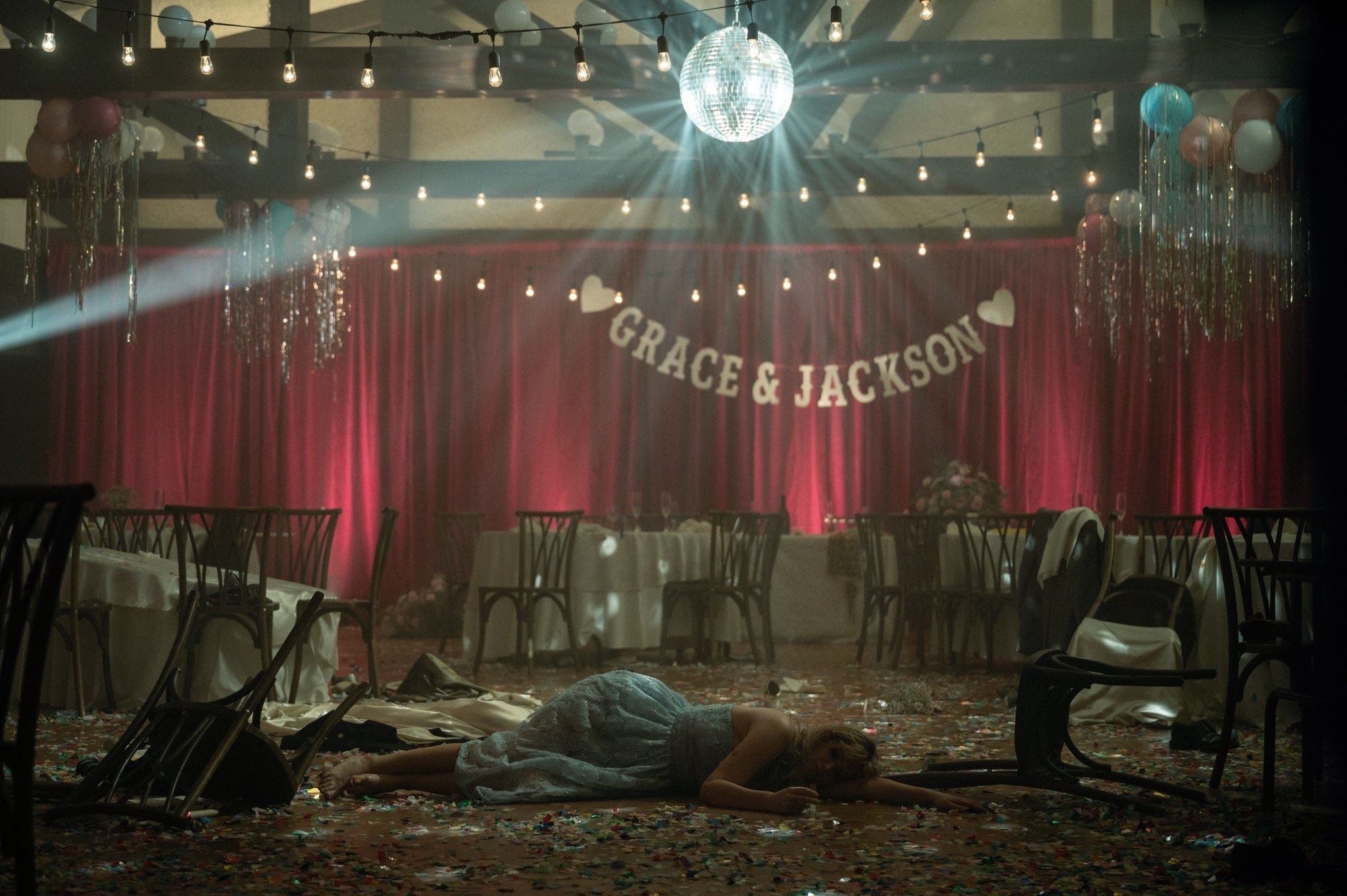
Die My Love is a 2025 American film directed by Lynne Ramsay, from a script co-written by Ramsay, Enda Walsh, and Alice Birch, based on Ariana Harwicz’s 2012 novel.
The film stars Jennifer Lawrence as Grace, a young mother battling postpartum depression, with Robert Pattinson as her partner Jackson. The supporting cast includes LaKeith Stanfield, Nick Nolte, and Sissy Spacek.
Die My Love defies categorization. Is it a drama? A thriller? A highly surrealist, pitch-black dramedy?
It’s not easy to say, for this is not an easy watch. Nor does it pretend to be, despite luring the audience in with the sensual essence of its lead.

Grace and Jackson flee New York City for the quiet of Jackson’s rural Montana childhood home, seeking peace as new parents. Instead, Grace finds isolation, psychological distress, and a relationship spiraling into unsettling territory. It’s a premise we’ve seen before, but Ramsay refuses to approach it conventionally.
Die My Love is relentlessly strange, surrealist, and provocative. The film makes bold visual choices, presenting naturalistic bare bodies and physical intimacy that feels both sexy and unnerving.
Ramsay doesn’t flinch from showing the raw physicality of new parenthood. The messy, uncomfortable, beautiful reality of it all.
However, these choices don’t always land. The pacing feels deliberately odd, sometimes maddeningly so. At a full two hours, the film runs long and occasionally feels flabby, particularly through its middle section, where scenes linger without clear purpose.
Nevertheless, this looseness might be intentional. The frustration audiences feel could mirror Grace’s own mental state—trapped, repetitive, unable to escape the monotony and mounting dread. Whether that justifies the runtime is another question entirely.
What grounds the film, despite its experimental impulses, is a surprisingly pointed thematic anchor. Late in the story, Grace delivers a line that encapsulates everything: “I don’t have a problem attaching to my son. He’s perfect. It’s everything else that’s f*cked.”

It’s a stark contrast to most stories about maternal depression. Without the emotional range and believably committed motherhood of Lawrence’s Grace, Die My Love would be sunk. But her love shines through, and so the choice mostly works.
Indeed, the film argues that Grace’s struggle isn’t about bonding with her child; it’s about surviving a world that makes motherhood unbearable. It’s a bold reframing that challenges typical postpartum narratives, refusing to pathologize Grace’s love while still acknowledging her suffering.
Furthermore, Ramsay leans heavily into a kind of arch-altered reality and unreliable narrative, creating mini-mysteries throughout. Is Grace cheating? Is Jackson? Both? Neither? Does it even matter when reality itself feels this unstable?
The film never fully confirms whether Grace is truly an unreliable narrator driving this madness, both literally and metaphorically. These ambiguities create unease but can also frustrate viewers seeking concrete answers. Ramsay seems more interested in emotional truth than literal facts.
Jennifer Lawrence carries the film almost entirely on her shoulders, and that’s a tall order even for an actress of her abilities. She’s a talented titan of her generation, already famous—or perhaps infamous—for solo-carrying films with varying degrees of success.
Here, her best moments recall her potent work in mother!, Silver Linings Playbook, and Joy.

Lawrence excels in scenes of quiet desperation and explosive volatility. She makes Grace’s deterioration feel visceral and immediate, never begging for sympathy but nevertheless demanding our attention. The performance is physically committed and emotionally raw.
That said, even Lawrence can’t overcome every scripting issue. Some scenes ask her to do heavy lifting without sufficient support from the material, leaving her stranded in moments that feel more affected than affecting.
The supporting cast provides crucial grounding. Robert Pattinson brings a realism and confused frustration to Jackson, avoiding the trap of playing him as either villain or savior. He’s simply a man struggling to understand what’s happening to his partner, the once effervescent mother of his child.
LaKeith Stanfield and Nick Nolte appear in smaller roles that add texture without stealing focus. However, the real revelation is Sissy Spacek as Jackson’s mother, Pam. She delivers a surprisingly understanding and empathetic performance, becoming one of the few characters who truly sees Grace, truly listens to her consistently.
Spacek’s Pam doesn’t coddle Grace, offering honesty when necessary. Yet she never dismisses Grace’s pain, and she’s one of the first to offer help, having recently gone through tragedy herself.
It’s a masterclass in a truly supporting performance, providing warmth without sentimentality and making great use of limited screentime.
The film’s surrealist elements will alienate some viewers while captivating others. Ramsay employs jarring cuts, dreamlike sequences, and visual metaphors that don’t always cohere into a unified aesthetic.
Sometimes the strangeness illuminates Grace’s fractured mental state; other times it feels like strangeness for its own sake.
Ultimately, Die My Love is about choices—the bold choices Grace and Jackson make within the story, and the equally bold choices Ramsay makes as a filmmaker.
Moving to Montana, having a child with your local sweetheart, getting married on a whim. Or choosing what to show and what to cut, running longer than necessary, focusing intensely on your lead actress at the expense of ensemble balance.
These choices definitely don’t all work. The film is long, often scattered, and a bit too comfortable with its own inscrutability. Some viewers will find it pretentious; others may find it profound. It defies easy judgments along with easy answers.
Nevertheless, there’s something admirable about the attempt. In an era of safe, algorithmically optimized storytelling, Die My Love swings wildly and takes its hits with its misses. Yet when it connects, it hits hard, offering images and ideas that linger uncomfortably long after the credits roll.
For those willing to meet the film on its own challenging terms, there’s substance beneath the surrealism. For everyone else, this might be a love affair best left undeclared.
Die My Love will be available in theaters on November 7th.
Follow us on X and on Instagram!
Like us on Facebook!
Quinn Quē

Quinn Quē is a storyteller & journalist writing regular interviews, reviews, and features. They've been fascinated with the multidisciplinary arts since a child, particularly film, literature, and television. They love microblogging, so feel free to hit them up on Substack Notes or Tumblr about any recent articles or just to shoot the pop culture breeze!