
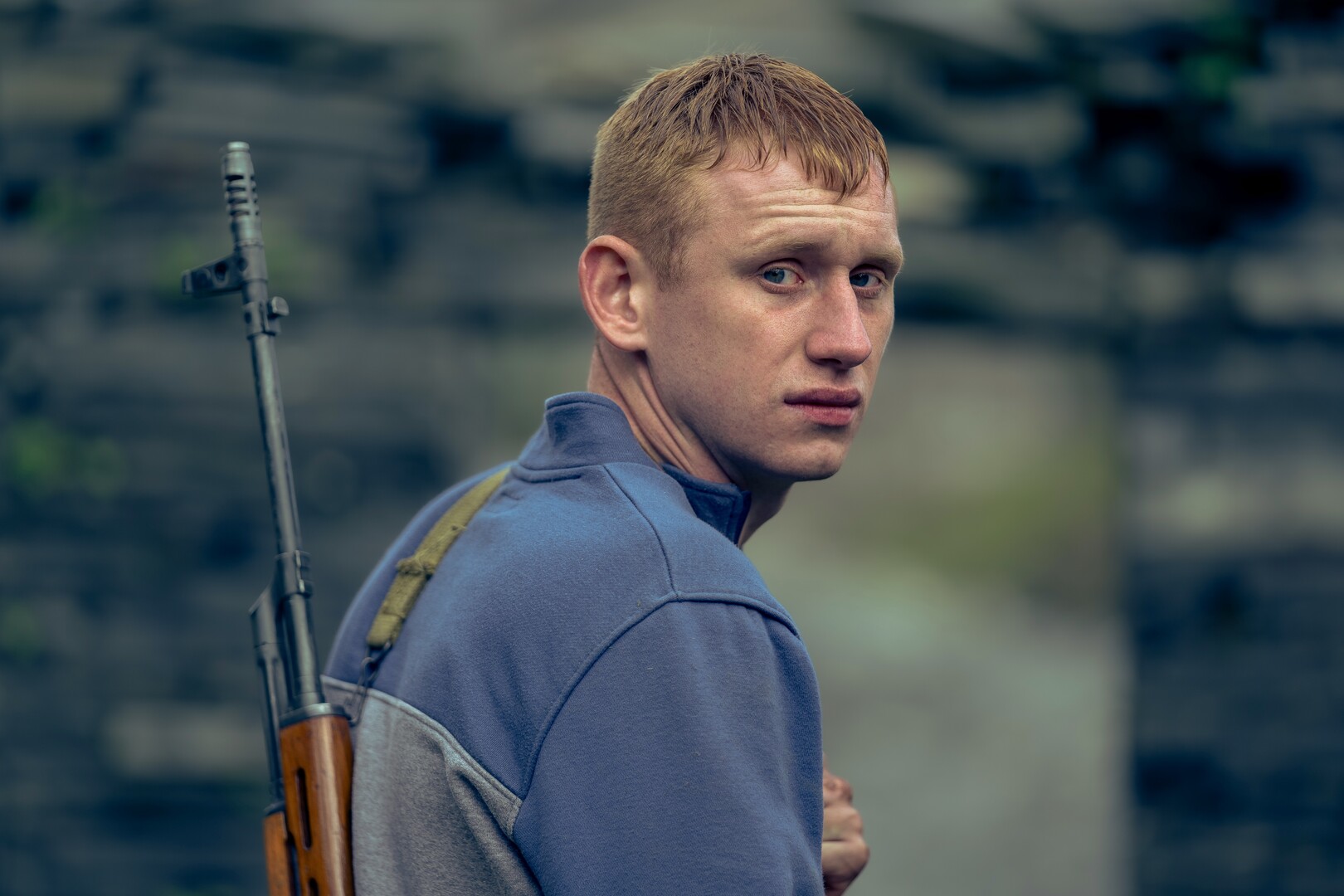
Eulalie Magazine spoke with Hayder Rothschild Hoozer about his short Rock, Paper, Scissors. We asked him about the motivation behind his story, the recognition from Ukraine, and what it all means to him.
Eulalie Magazine: What motivated you to tell this story?
Hayder Rothschild Hoozer: The motivation came from a need to return the narrative of war to the ground. When conflicts are reported at scale, they quickly become abstract. Numbers replace people. Attention moves on. What gets lost are the private moments where ordinary individuals are forced into impossible choices simply to keep others alive.
When this story came to us, it wasn’t framed as heroism. It was about responsibility. A young person doing what had to be done because there was no safe alternative. That distinction mattered deeply to me. Rock, Paper, Scissors is not about victory or bravery in a cinematic sense. It’s about the quiet, devastating weight of action when inaction is no longer an option.
The film exists to slow the audience down and sit them inside that reality. To honour the civilians, families, and young people who don’t choose war, but are shaped by it forever. That felt urgent, and sadly, it still does today.
Eulalie Magazine: What does it mean to you to have such support from Ukraine and have them recognize the short and its awards?
Hayder Rothschild Hoozer: It means everything, because the recognition has come from the Ukrainian community itself, both within Ukraine and across the diaspora. These are people who carry this reality daily, whether on the ground or far from home, and their response has been rooted in lived experience. That level of engagement tells us the film resonated where it mattered most.
The support from the Office of the President of Ukraine is significant. It acknowledged the film as a deeply human testimony and recognised the responsibility we took in preserving memory, dignity, and truth. That endorsement affirmed that the story was handled with care, authenticity, and respect for those whose lives it reflects. This meant that what we set out to do with the film, to build a bridge for empathy through storytelling, is working.
From the beginning, this project was built on collaboration with Ukrainians at every level, from language and performance to cultural detail. The recognition the film has received confirms that this approach was felt and understood. Awards amplify visibility, but being embraced by the people whose history and present the film speaks to is what gives the work its lasting meaning.

Eulalie Magazine: Do you think there is a big difference between telling the story of an ongoing war as it’s happening rather than waiting a few years to tell what happened?
Hayder Rothschild Hoozer: There is a weight of responsibility that comes with telling a story of a war as it is still unfolding. When events are ongoing, the wounds are open, the consequences unresolved, and the people affected are still living inside the aftermath. That immediacy demands precision, humility, and restraint because there is no distance yet between what is happening and what it means.
As a producer, that responsibility sat at the centre of how I approached the project. My role was to protect the integrity of Ivan’s story at every stage, from development through to release. That meant creating space for Ukrainian voices, surrounding the film with the right collaborators, and continually asking whether each decision served the truth of the experience rather than the momentum of the film itself.
Telling the story now allowed us to preserve an emotional truth before it became filtered through distance or historical framing. It captures uncertainty as it exists, fear without resolution, and decisions made without the comfort of knowing how things end. That honesty is difficult to recreate years later. Supporting the film while those realities were still active required care, restraint, and accountability, because there was no distance to hide behind.
It also demanded constant listening to those directly affected. The intention was never to define the war, but to reflect a human moment within it, one that exists across conflicts and generations. By telling the story as it unfolds, the film becomes part of the present, a record of how this moment felt to live through rather than a summary written after the fact.
Eulalie Magazine: Why was it important to you to get approval from the office of the President of Ukraine?
Hayder Rothschild Hoozer: The support from the Office of the President of Ukraine was important because it recognised the film as a form of cultural diplomacy. The intention behind the project has always been to help build empathy for the civilian experience of the war and to allow that understanding to travel beyond borders, politics, and proximity.
As non-Ukrainians, our responsibility was to use our position carefully. We are able to reach audiences who may feel distant from the conflict or overwhelmed by its scale. The film creates a human entry point, one that says if we can understand what is happening to ordinary civilians in Ukraine, then so can everyone else. That is where advocacy through storytelling becomes meaningful.
The support from the Office of the President affirmed that this approach was understood and welcomed. It recognised the film as a bridge between lived experience and international audiences, helping to shape empathy, preserve memory, and keep the human cost of the war present in global consciousness. That alignment gave the work a wider purpose beyond the screen and reinforced the responsibility we carry in how the story is shared.
Eulalie Magazine: If you could have one thing that viewers take away from this short, what would it be?
Hayder Rothschild Hoozer: I would want viewers to recognise themselves in the people at the centre of the story. To feel how thin the line is between safety and chaos, and how quickly an ordinary life can be reshaped by forces outside of one’s control.
The film asks audiences to understand that behind every headline are ordinary people making impossible decisions simply to keep others alive. These choices are rooted in familiar instincts: protecting family, protecting community, refusing to abandon those around you.
If the film stays with people, it’s because it shifts how they see those lives. That shift is what shapes understanding, and understanding is where real empathy begins.

Eulalie Magazine: What does it mean to you to be an Oscar-Shortlisted Live Action Short Film?
Hayder Rothschild Hoozer: It’s humbling, and it feels like a genuine vote of confidence from an industry I’ve admired my entire life. Film was an escape for me growing up, and it also gave me a sense of belonging to something bigger than just me. Through cinema, I felt connected to cultures, emotions, and lives that were far from my own, yet deeply familiar on a human level.
Being shortlisted places the film on a global stage where it can reach audiences who might not otherwise encounter it, and that visibility matters because of what the film represents. It amplifies the film’s voice, keeps the conversation active, and preserves focus on the civilian experience. It allows the story to continue doing what cinema has always done at its best, opening windows into other lives and encouraging us to see the world, and each other, with greater understanding.
For me, that sense of reach and connection is what makes this moment meaningful. It’s a reminder of why I was drawn to film in the first place and why stories rooted in human experience continue to matter.
Eulalie Magazine: Do you have any upcoming projects you’re excited about?
Hayder Rothschild Hoozer: I’m developing a slate of work, with one particular feature that explores aspiration and the desire to want more from life than what your circumstances initially determine. It’s about movement, ambition, and the courage to imagine a different future for yourself. That impulse isn’t tied to one place or one background. It’s human, and it’s something everyone understands.
The work ahead continues the belief that sits at the heart of Rock, Paper, Scissors. That cinema doesn’t just reflect the world, it actively shapes it. Films have the power to influence how we think, how we feel, and how we relate to one another.
I’m a romantic at heart. I believe in cinema that restores a sense of adventure and excitement, and that uses storytelling as a force for cultural and societal change through shared human experience.
Follow us on X and on Instagram!
Like us on Facebook!
Lara Rosales

By day, Lara Rosales (she/her) is a solo mom by choice and a bilingual writer with a BA in Latin-American Literature known as a Media Relations Expert. By night, she is a TV enjoyer who used to host a podcast (Cats, Milfs & Lesbian Things). In addition to Eulalie Magazine, you can find her work published on Tell-Tale TV, Geek Girl Authority, W Spotlight, Collider, USA Wire, Mentors Collective, Instelite, Noodle, Dear Movies, Nicki Swift, and Flip Screened.