
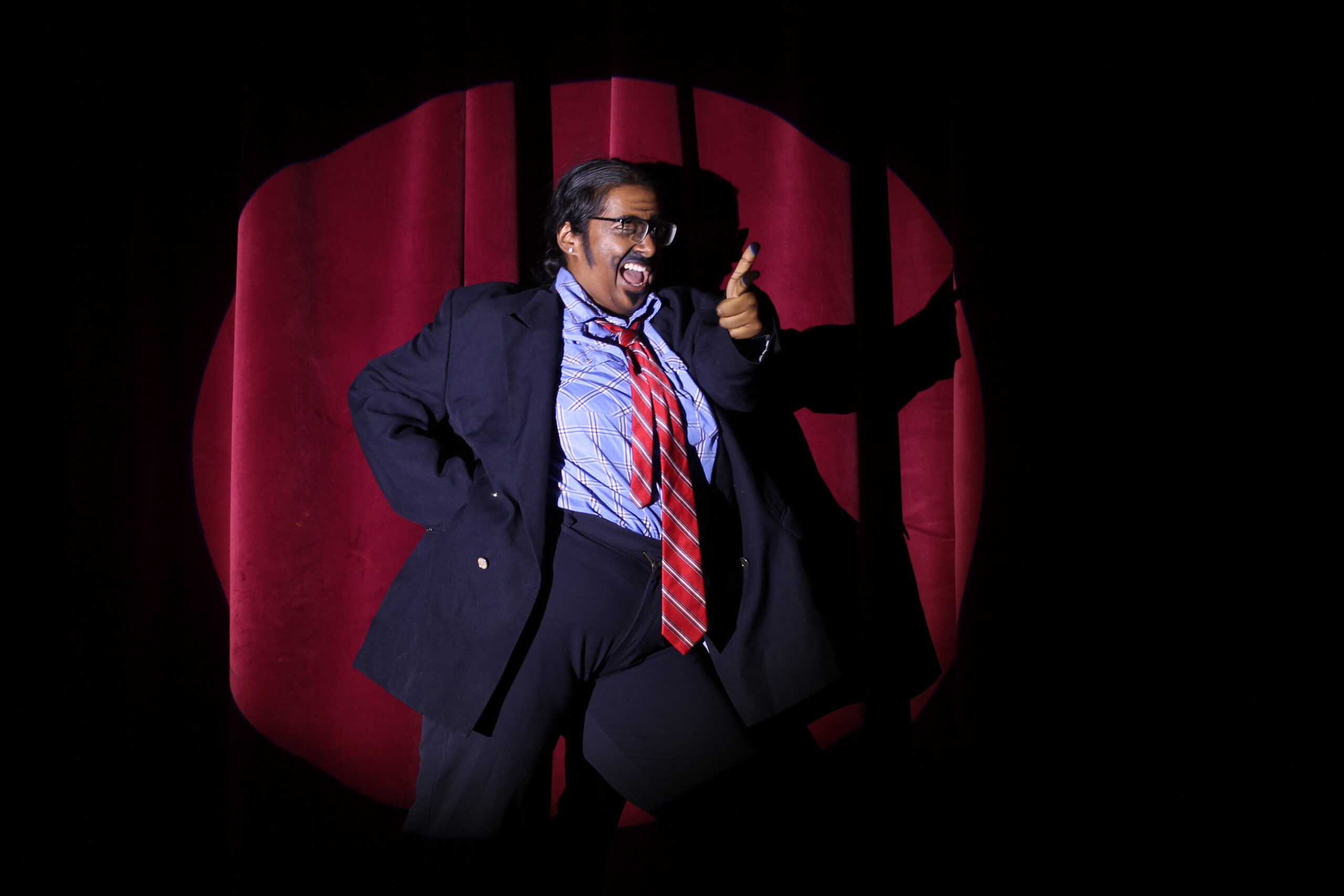
If anyone understands the hustle and grind required to climb the ladder of thought leadership success, it’s a secondhand Tesla owner. Enter Santosh Santosh, the host of an “almost-award-winning” podcast who’s convinced he’s on the brink of greatness. He’s also the brilliant creation of multidisciplinary artist Srutika Sabu, whose new show 1 Santosh Santosh 2 Go: Live at Grind-Con! is taking the Toronto Fringe Festival by storm. Audiences can see Srutika bring Santosh to life in a wildly original, bold production, complete with delightful physical comedy and a smattering of cringe-inducing motivational speaker energy for good measure. Her drag king persona is truly one of a kind.
I had the privilege of chatting with Srutika about leaving medicine to pursue comedy, creating Santosh, her favorite segment from Live at Grind-Con!, and more.
This interview is edited for length and clarity.
Srutika Sabu’s Origin Story
Eulalie Magazine: I was reading about your background, which is so fascinating. What was the impetus for you behind leaving medicine to pursue comedy?
Srutika Sabu: Those two things happened separately. I went to med school in the States. The class I was taking in October 2018 was called Research-Based Health Activism. It felt like a humanities class, where we talked about different medicine and community-based activism and work. This was also the height of Trump’s first era. There were a lot of conversations about that. That’s why we were pretty politically engaged.
We were talking about, if not medicine, what would we do if we had all the money in the world. At the time, I didn’t know it would be a theater company/production thing or just creating art for a living. I ended up ugly crying after that. My friends were so kind. [They were] like, “I think you need to take a year off,” which is considered a death sentence in terms of medical stuff. I was like, “I think that is exactly what I need to do,” which meant I couldn’t stay in the US.
I had to return to Toronto — I hadn’t been here since I was 15. It was a huge cultural thing. Illustration and music are my first primary loves. I was like, “I’m going to do all the things.” That was November 2019. I was like, “I have a whole year.”
Eulalie Magazine: Before the world shut down?
Srutika Sabu: The world shut down. That, I think, is the funniest. Awful, obviously, because I was also dating a physician at the time. I saw my friends go through the trenches because they were also under residency. I felt like a draft dodger. The point is, I got a lot of time to think about what I want to do. I knew it wasn’t medicine. It was slowly giving myself permission to do that, which is a little hard when you have South Asian parents who care.
Part of that was trying out different things. There were improv classes at the Comedy Bar Danforth in the East End. I gave it a try. That was this huge entryway into this other world I didn’t know existed.
Then, I went through my first Toronto Fringe season in 2022. That introduced me to clown and to the larger comic community. I gave that a go, and now I’m here, which I’m constantly surprised by.
Eulalie Magazine: What was the inspiration behind Santosh Santosh as a character?
Srutika Sabu: He is an amalgamation of a couple of archetypes. One is a middle-aged South Asian man. We call each other “uncles” and “aunties” all the time at a certain age, and he’s a South Asian uncle. I think the charming part of South Asian uncles, though, is they say things with such confidence. Also, not to deny that they don’t have wisdom, but there’s a certain optimism to them. Also, this unapologetic taking up of space. They will send good morning WhatsApp forwards with their name signed on them, and it’s both baffling but also on-brand and endearing.
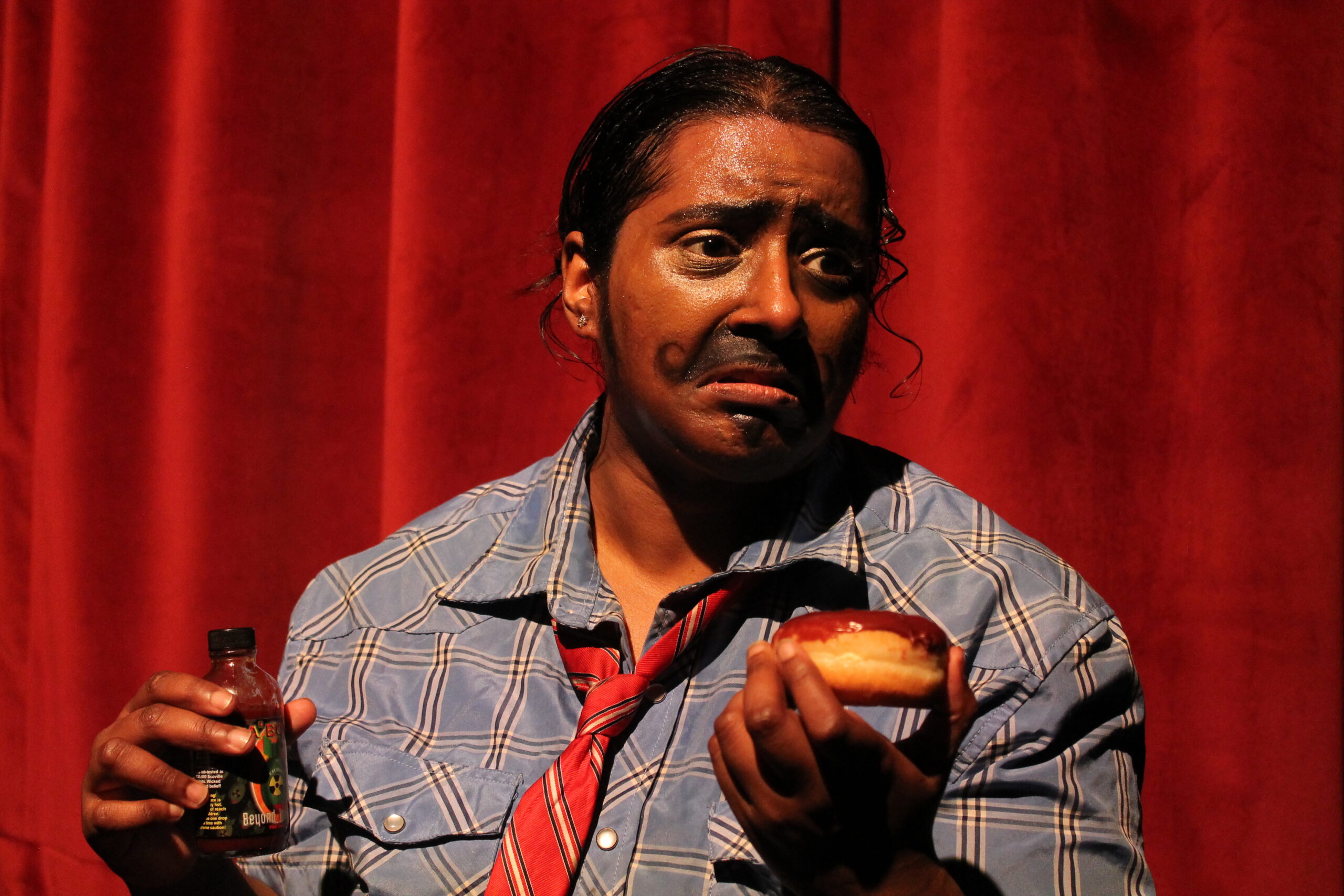
There’s also the tech-bro stereotype. Especially in the US, I know quite a few friends who have some adjacency to the stereotype. I feel like it’s a combination of a specific type of working archetype — tech-bro archetype, Desi uncle. Then, of course, there’s this wrapping duct tape of mediocrity to him. He tries so hard, but he’s only secondhand, hence why his podcast is called Second-Hand Success, and he’s a secondhand Tesla owner.
1 Santosh Santosh 2 Go: Live at Grind-Con!
Eulalie Magazine: Let’s talk about your new show, 1 Santosh Santosh 2 Go: Live at Grind-Con! What can audiences expect when they watch it?
Srutika Sabu: This is the second Santosh Santosh Show at Toronto Fringe. The first was in 2024. Ken Hall directed it. It features the same character and the same world, but that was definitely more of a clown show. It’s not a whole scripted thing. There was also a co-star, so there were more clown games and style to it. This time around, it’s something I got to author on my own.
Last year, I was in the Buddies Emerging Creators Unit. Part of that is you get selected, you get development to work on a 45-minute piece, and then you showcase it during Pride Month. Basically, it’s that same show. When creating that show, I wanted to lean in. It was funny because last year, as Elon Musk was becoming less cool, we did the first Fringe show at Toronto Sketch Fest.
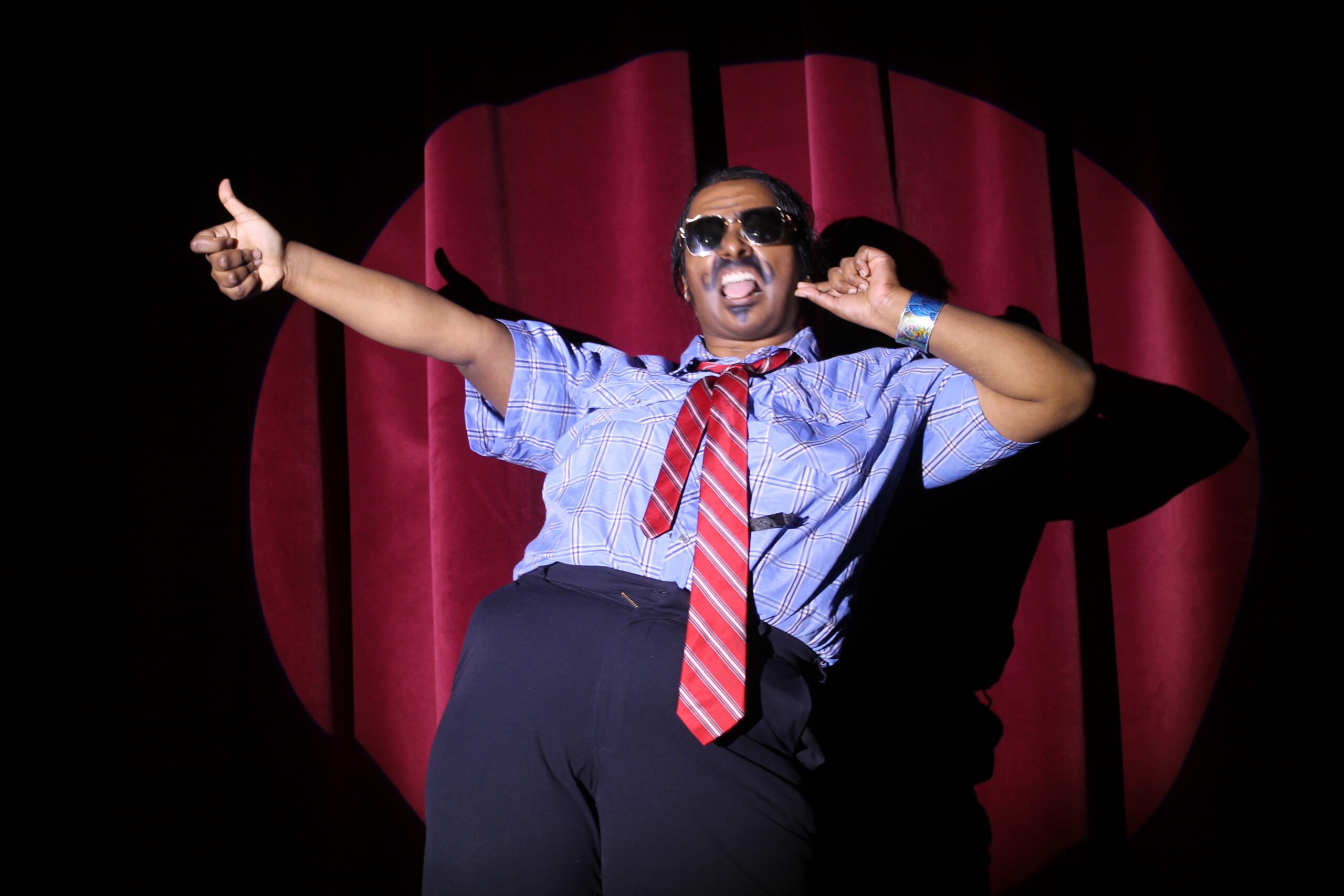
It is a comedy show. It’s almost a one-act play, and then it has beautiful physical theater bits and stuff. Also, you get to hear Santosh speak, because in the original show, Santosh didn’t speak. Now you get to hear him speak. It’s called Live at Grind-Con! because he attends a LinkedIn influencer conference. They have a last-minute opening, and he’s the last-minute speaker. He’s so excited because it’s the height of his thought leadership career. He goes in for the ride and brings his secondhand Tesla on stage. That’s essentially what it is.
Eulalie Magazine: Describe your show using three words.
Srutika Sabu: Cathartic. Bizarre. A lot of heart.
Eulalie Magazine: Can you talk about how your show’s themes of tech-bro culture and toxic masculinity intersect with South Asian identity?
Srutika Sabu: A lot of computer science majors out there, at least the ones I know, are South Asian men. On one hand, Silicon Valley is interesting because they feel represented. Then they also have people like Sundar Pichai, who’s the CEO of Google. It’s like, “Oh, we can make it.” There’s an optimism. This is a place that we can exist and do well, and it’s based on “merit.” There’s a particular South Asian flavor to it, where I think a South Asian masculinity is often compromised or questioned, especially when you put it next to mainstream white versions of masculinity.
At the core of the show, there’s a lot of commentary on the manosphere, for sure, in terms of the current conversations. This is a man who’s trying on that mask because he thinks that’s what he’s supposed to do. Then throughout the show, he unravels that in a hilarious, bizarre, and satisfying way, where he realizes a lot of the things that he held was really duct tape about wanting to fit into a larger white society. Especially in terms of model minority myths and the idea of being good enough to be invisible. Those are themes that are very much explored in the show through silent musical sequences and also fake podcast clips.
Eulalie Magazine: How do you incorporate your own background into your work?
Srutika Sabu: Santosh is the same background that I am. Specifically, he’s South Indian, but more specifically, he’s Malayali, which I am, too. I think Santosh has a very similar diasporic experience to mine because I more or less grew up in Brampton. Then, around age 15, my parents and the whole family decided to move to New Jersey, which was experiencing a different South Asian diaspora. It’s very different. Then, also being surrounded by a lot of computer science, software engineers who are brown, working at all these very upper-middle-class places.
Then, coming back here, it’s also so strange because they’re both very different South Asian diasporas, and also they’re very different countries. I incorporate that into Santosh. Even odes to South Indian cinema, with Tamil and Malayalam songs and different cultural elements. He’s unapologetically South Indian, especially when larger South Asian narratives tend to be very North Indian or Hindi-centered. My hope is to bring that visibility and celebrate that a bit more.
Eulalie Magazine: Are there any segments or jokes that you can tease from your show?
Srutika Sabu: My favorite segment — even Santosh says it’s his favorite segment — is, he’s like, “Well, it’s the 200th episode. In honor of the 200th episode, I’m going to show you how Tessa and I met.” It’s literally set to almost like a Kollywood romantic song. It’s just him making love to a Tesla. It’s the one that everyone goes, “Wow, that was uncomfortable, but also I can’t look away.”
Eulalie Magazine: What do you hope audiences take away from your show?
Srutika Sabu: There are a lot of conversations we’re having about diversity. In Canada, we feel like we’re a bit insulated from it, but it is coming. I think in their politics, it’s definitely approaching. It’s a place, I think, to make fun of ourselves through watching someone who we think is more cringe than us.
Also, through this very lighthearted veneer of it, explore some very serious themes about identity, fitting in. Questioning this idea of meritocracy, like, just working hard doesn’t necessarily mean success, but when do we stop and understand what it is that we really want and who we are? It’s a very complicated journey of doing that. I hope people walk away from it being like, “That was very strange. What did I just watch? I also found it very fascinating and very funny.” Also, yes, that’s some very serious conversations about identity and authenticity.
Eulalie Magazine: Who are your comedy heroes?
Srutika Sabu: Clown is one of the reasons why I do half the things I do. Honestly, in terms of that alone, I have to shout out everyone, all my clown teachers at Sweet Action Theatre, which is the premier clown theatre in Toronto. Isaac Kessler, Ken Hall, Gordon Neill. Through that, I got to do a class with clown master Deanna Fleischer, who is actually the reason Santosh exists at all. I took her drag king clown class at Sweet Action Theatre while she was visiting.
All these trainings really taught me so much about the power of presence and taking your time and just being very good on stage. In terms of writing, it’s a lot of British things. Lisa McGee from Derry Girls. Miranda Hart. She’s also great.
One of my favorite YouTube channels is Characters Welcome. It’s from the Upright Citizens Brigade. They do some phenomenal writing with solo character sketches that has influenced my sensibility. I love the witty writing and dry sensibilities of British humor with the silly slapstick clown sensibilities of LA clown. Also, a lot of anime. Anime weirdly influences me, especially physicality and timing.
On the Horizon
Eulalie Magazine: Is there anything else on the horizon for you, career-wise?
Srutika Sabu: I got my first Canada Council grant for research and creation last year. I’ve been working on a two-part musical about a talking cow haunting two generations of a South Asian family called My Beef with Beef.
It’s about South Asian culture and diaspora and the idea of authenticity through food, essentially. We have a lot of conversations about authenticity, but we’re still trying to explain ourselves to people who are not South Asian. How that relates to selling your culture, especially in terms of food culture, to a non-South Asian audience and the dynamics that come from that. Yes, it’s meant to be funny. I’m still trying to figure that out. It’s getting there.
Eulalie Magazine: Have you watched anything interesting lately?
Srutika Sabu: I watched Take Rimbaud at Buddies. What I liked about that is it used space in a very particular way. It reminded me that there’s something that theater can do that film cannot. That is movement in space, where theater can do both time montages and cuts, if you think about it, in the same way film can. Obviously, one of the limitations is locations or world. You can evoke that with theater, though not to the same fidelity.
With that, you also gain space. It had a really interesting stage design, which was multi-tiered and also played with this idea of fourth wall really well, which, again, is something only theater can do. I was reminded of that while watching it. This would be very hard to make into a film. I don’t think that’s a bad thing.
Eulalie Magazine: There’s a real immediacy to theater, too, that you can’t get with film.
Srutika Sabu: Absolutely. Yes.
1 Santosh Santosh 2 Go: Live at Grind-Con! will be playing at Toronto Fringe until July 12.
Follow us on X and on Instagram!
Like us on Facebook!
Melody McCune

Melody loves TV. Maybe too much. Besides being a Senior Writer for Eulalie Magazine, she’s the Managing Editor for Geek Girl Authority, an Independent Contractor for Sideshow Collectibles, and a Senior Writer for Tell-Tale TV. Additionally, she has bylines in Culturess, Widget, and inkMend on Medium. To top it all off, she’s a critic for Rotten Tomatoes and CherryPicks.